
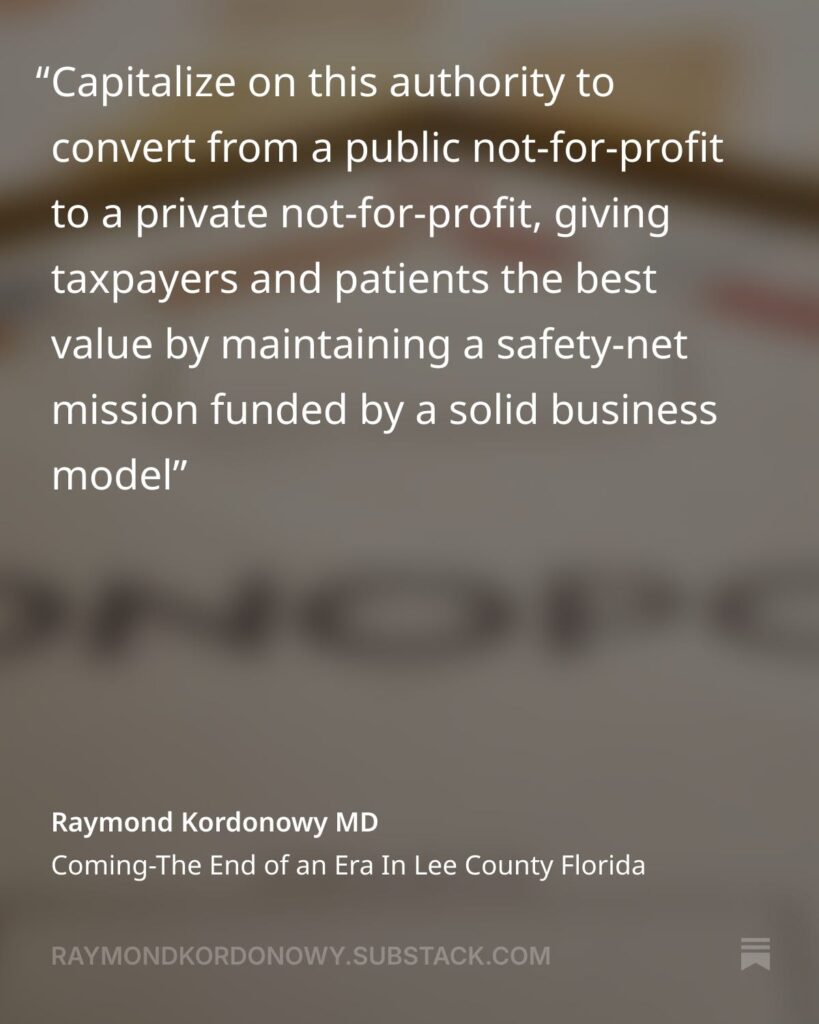
In an op-ed piece in 2023, former Lee Health CEO, Jim Nathan, offered this as the option Lee Health would be taking after its board voted to move forward and dissolve their 50-year state chartered Public, nonprofit health care system.
As a physician practicing in Lee County, I have watched the healthcare environment in our community become progressively more complicated for patients. The problems are not limited to the cost of healthcare or the availability of physicians. The access to physicians has gotten beyond unreasonable. I will acknowledge, a bigger explanation of physician shortage is due to Medicare payment rules for physicians but these payment rules have promoted hospital ownership of physician practices. Lee Health hasn’t resisted these policies. To the contrary, they have relished in the preferential payment hospital locations get for physician owned patient care.
A newer reality that our patients are experiencing is being shuffled out of Fort Myers and hospitalized in nearby towns due to the existence of competing hospital feeder operations. The Lee Health monopoly continues to hold onto its control accentuated by the lead it was handed when it dissolved its public charter. We won’t be seeing any new competing hospitals in our city for years to come.
It turns out that instead of having actual competing hospitals within Fort Myers, we have outside hospital systems building stand-alone emergency rooms within our town walls. Patients are arriving at these facilities after hours and with acute complaints. IF the evaluation results in a recommendation for hospitalization, patients are being told they will be hospitalized at the mother-ship hospital.
Florida AHCA classifies the West Fort Myers facility as a hospital-based off-campus emergency department of HCA Florida Lehigh Hospital.
HCA Florida Cape Coral Emergency — affiliated with HCA Florida Fawcett Hospital. It is a freestanding/hospital-based off-campus ED in Cape Coral.
AdventHealth Cape Coral ER — affiliated with AdventHealth Port Charlotte. This is another freestanding hospital emergency department.
NCH Emergency – Bonita Freestanding — affiliated with NCH Healthcare System in Naples, located in Bonita Springs.
There is another aspect of patient access that I believe deserves greater public attention. It concerns what happens when a patient enters an emergency department operated by a competing hospital system.
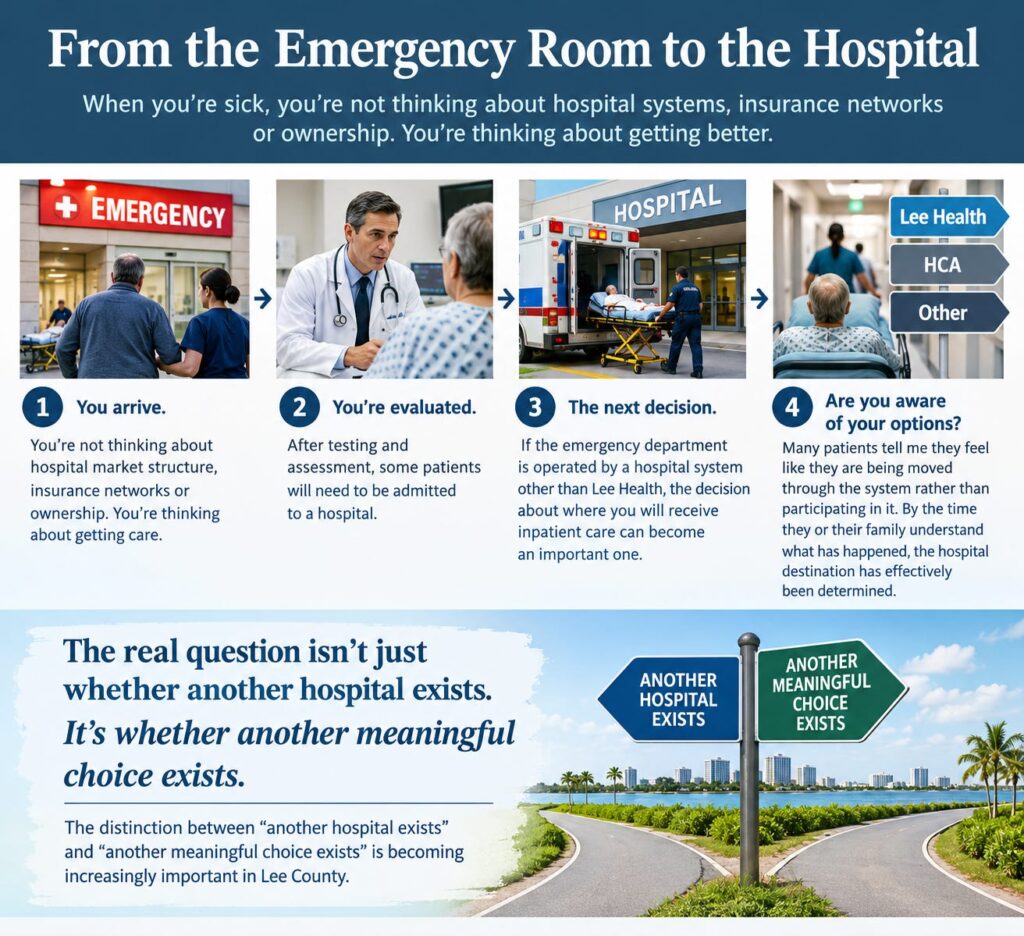
Patients generally do not arrive at an emergency department thinking about hospital market structure, insurance networks or the ownership of the facility. They arrive because they are sick. Once evaluated, some patients will need to be admitted to a hospital. If the emergency department is operated by a hospital system other than Lee Health, the subsequent decision about where that patient will receive inpatient care can become an important one.
I have heard from patients who describe the healthcare system as though they are being moved through it rather than participating in it. A patient enters one emergency department, is told that hospitalization is necessary, and is subsequently transferred to another facility. By the time the patient or family understands what has happened, the hospital destination has effectively been determined. It is reasonable to ask whether the patient understood that there were alternatives.
The problem becomes particularly important in Lee County because the distinction between “another hospital exists” and “another meaningful choice exists” is becoming increasingly important.
Does the patient understand that alternatives may exist? Is the patient told which hospitals are available? Is the patient’s insurance network considered? Is the patient given an opportunity, when circumstances permit, to express a preference about where the hospitalization will occur? And does the patient understand the financial implications of that decision?
These are not merely questions of hospital regulation. They are questions of informed patient choice. This type of care patterns tie into the whole surprise billing debate going on in Washington. From what I am hearing from my patients, they are not being informed that they have options to seek a preferred hospital transfer from a stable emergency room bed. I doubt patients really want to move their care out of town. If provided informed consent and Lee could offer an actual bed, they would likely request transfer to a Fort Myers hospital.
From my experience with our Lee Health hospitals, I sincerely doubt the administration has attempted to address a bed census access or transfer hotline for these “non Lee Health” emergency access points. Failing to anticipate this situation nor provide physician and patient informational updates regarding these access point realities, is another mark of failure on our hospital system.
Hospital bed access has not improved. Busy season is just getting started.
Cardiology follow-up, even for established patients is months out. Private practice cardiology access in Lee county has never been this low.
Patient’s needing specialized procedures for heart rhythm management EP(electrophysiology) studies and conduction ablation procedures are 6 months out. Patients hospitalized with unstable rhythm issues will not be bumped up the EP schedule. The rumor is this is due to long Operating Room times required for these studies; there isn’t availability. That is a failure on the hospital system as they control the physical assets for these services. With Lee Health’s recent cardiology group joint venture, cardiology specialty choices have withered further. We are having to refer patients out of the community for such services.
Gastroenterology practices have mostly rolled up into three large corporate owners. Gastro Health, United Digestive and Lee Health’s Digestive Health Institute. Our community of doctors are aging out and corporate buy-outs are the reality of the day. Our young physicians aren’t prepared to buy existing practices.
Our oncology physicians have experienced business shifts affecting access to cancer services as well. McKesson, an American multinational healthcare infrastructure, pharmaceutical distribution, and medical technology company has a 70% stake in what was prior to the merger, our largest and finest cancer group in our community, Florida Cancer Specialists. Lee Health is building its own cancer care program. Time will tell whether these business changes improve access for our town.
These above mentioned realities mean that it is even more imperative that our primary care physicians sharpen our skillset and are necessarily tasked with managing more specialty care while the lines for specialty access get longer. As the cardiology update indicates, even hospitalization doesn’t mean you will get quicker definitive management.

Patients and employers are asking me what to do in response to Lee Health’s decision to end contacting with United Health. Initially, I thought this was only about Medicare Advantage contacts but that isn’t the case. This is no small-potatoes issue.
The potential scale of the change is considerable. Lee County has approximately 372,000 residents with employer-based health insurance. Applying UnitedHealthcare’s approximately 25% share of Florida’s group health-insurance market produces an estimated 90,000 to 95,000 Lee County residents with UnitedHealthcare employer coverage. Separately, UnitedHealthcare covers approximately 40,000 Lee County residents through individual Medicare Advantage plans. Taken together, these figures suggest that roughly 115,000 to 135,000 Lee County residents could be affected by the loss of Lee Health’s in-network status, although the commercial portion is an estimate rather than a county-specific enrollment count.
The UnitedHealthcare termination raises a significant question concerning compliance with the commitments Lee Health made to Lee County when it converted from a public hospital district to a private nonprofit. The Mission Agreement expressly contemplated preservation of Lee Health’s safety-net role, continuation of existing programs and services for Lee County residents, and continued participation in Medicare and Medicaid. Lee Health has now elected to terminate its hospital and medical-group contracts with UnitedHealthcare, effective December 31, 2026, making its entire hospital and physician system out-of-network for affected UnitedHealthcare Medicare Advantage members beginning January 1, 2027. Although the agreement’s Medicare covenant expressly concerns traditional Medicare rather than Medicare Advantage, the magnitude of the network withdrawal raises a separate question whether the decision is consistent with the agreement’s broader commitments to maintain programs, services, and access for Lee County residents and to preserve Lee Health’s safety-net function.
Has Lee County determined whether the UnitedHealthcare termination is consistent with the Mission Agreement, and specifically whether the effect on Medicare Advantage beneficiaries and other UnitedHealthcare patients constitutes a material reduction in access to existing programs and services? I searched and failed to find any confirmation that the oversight entity which was promised to be a necessary “referee” to monitor Lee Health’s commitments has even been hired by the county. I have sent a public records request to confirm with the county the status of that oversight entity and any work product that might exist.
From what I, my fellow doctors, and patients are experiencing and reporting in our day to day care, things are not improving and instead rapidly deteriorating. Forcing so many citizens in our county to have to access our only community hospital locations and Lee Health-owned physicians as out-of-network points of care, is a dereliction in duty regarding their past charter and their subsequent promise to maintain community access and care. This was a stated primary objective given their 50-year legacy as a publicly charted, nonprofit hospital system. I think a public meeting to confront these access concerns is not an unreasonable call to action. What say you, Lee county?
Disclaimer: This information is for educational purposes only and is not intended to replace professional medical advice, diagnosis, or treatment. Always seek the advice of your physician or other qualified health provider with any questions you may have regarding a medical condition.

Discover direct, priority access to Dr. Kordonowy for comprehensive wellness and proactive care. Take the next step toward a higher standard of health by booking a complimentary visit or comparing our membership plans.
Southwest Florida’s premier Medical Home. Dedicated to prevention, access, and the patient relationship. Serving Fort Myers, Sanibel, Cape Coral, Bonita Springs, Naples, Punta Gorda & surrounding Southwest Florida areas.
Contact
6160 Winkler Road
Fort Myers, FL 33919
(239) 362-3005
Fax: (239) 362-3392
staff@imlwp.com