
As the midterm elections approach, my social media feeds and the lay press keep batting the idea of Medicare For All vs “whatever else”. I am pleased to see fellow colleagues soundly educate the public (which includes many physicians who missed learning important economic principles) about how real markets actually work.
Fellow Substack and X active physician, Dr. Anthony DiGiorgio reposted Brivael Le Pogam’s X post describing the school yard marble economy. This post beautifully illustrates the critical concept of price and explains why a central authority cannot set an accurate price for everyone: no single entity can know how each individual values a given item. Healthcare is no exception.
This missing element is at the root of the healthcare debate. For more than a decade, all we have been able to say is that health insurance is becoming increasingly unaffordable, and we are thoroughly dissatisfied with the status quo. Meanwhile, Uncle Sam seems either paralyzed or cynically smiling while we twist in the wind.
The paralysis can be explained by overwhelming lobbyist power maintaining the current system. The more cynical explanation is that our elected politicians—perhaps particularly in the US Senate given their longer terms—are waiting for us to become desperate enough to beg for the corral trapdoor to close.

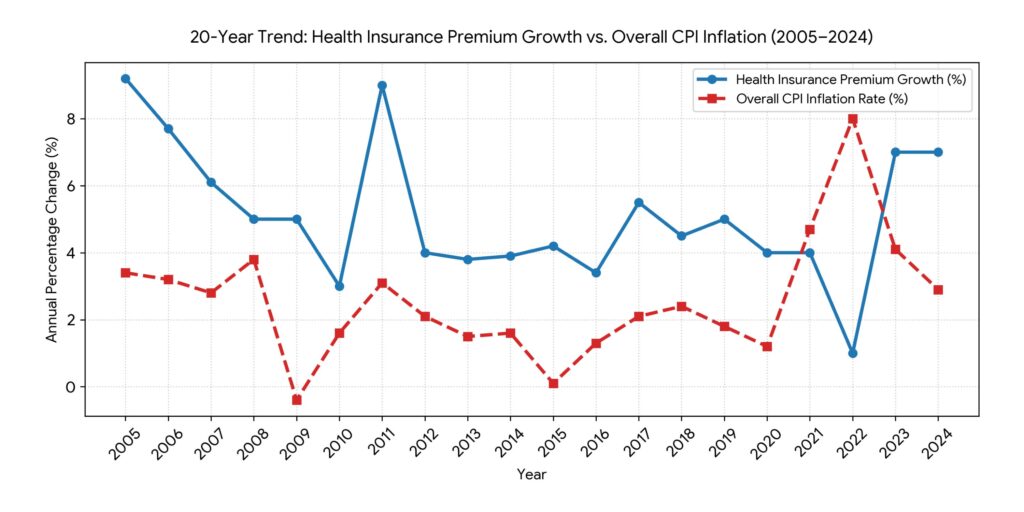
Relentless Cost Increases: Expenditures for insurance and out-of-pocket cash per individual have outpaced inflation for decades. While 2021 and 2022 were temporary anomalies, 2025 and 2026 proved to be even harder on consumers than 2024. During 2025 and 2026, health insurance premium inflation re-established its historical pattern of exceeding general economic inflation as health plans absorbed delayed medical cost surges. In 2025, average employer family health insurance premiums rose by 6.0% to $26,993—significantly outpacing the overall CPI rate of 2.6%. By 2026, premium increases remained elevated at 5.0% ($28,303 for family coverage), while CPI inflation adjusted to ~3.3%–3.7%.
Price-Fixing & Practice Overhead: Medicare’s Relative Value Unit (RVU) payment scheme has failed to account for rising independent physician office overhead—not by a single shred. This financial squeeze has forced most doctors out of private practice, making it increasingly difficult for patients to find independent physicians.
Shift to Hospital Systems: Medicare has consistently increased “facility fee” payments to hospitals and institutional care settings. This bias has accelerated the migration of the physician workforce into hospital networks.
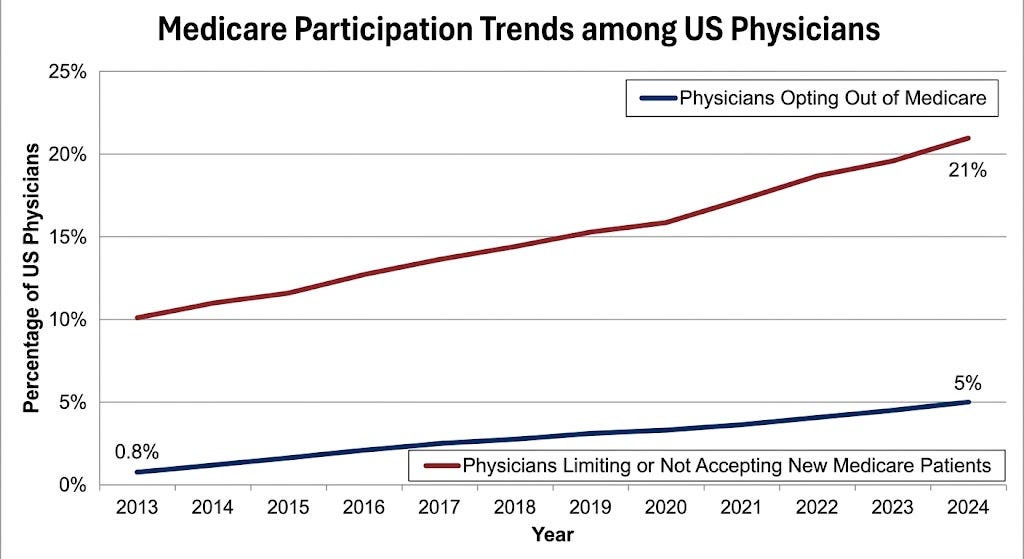
Physician Opt-Outs: The doctors most affected by these price controls are opting out of Medicare at rising rates. The trend makes it obvious that a “Medicare for All” system will only accelerate physician exit rates. The rise of hybrid concierge practices and the reliance on physician extenders as doctor replacements are direct side effects of these price controls and payment rules.
Administrative Burden: The cost of processing healthcare claims has become a massive tax on providers who contract with Medicare and commercial insurers—reaching an estimated quarter-trillion dollars annually in administrative costs incurred simply to pursue payment.
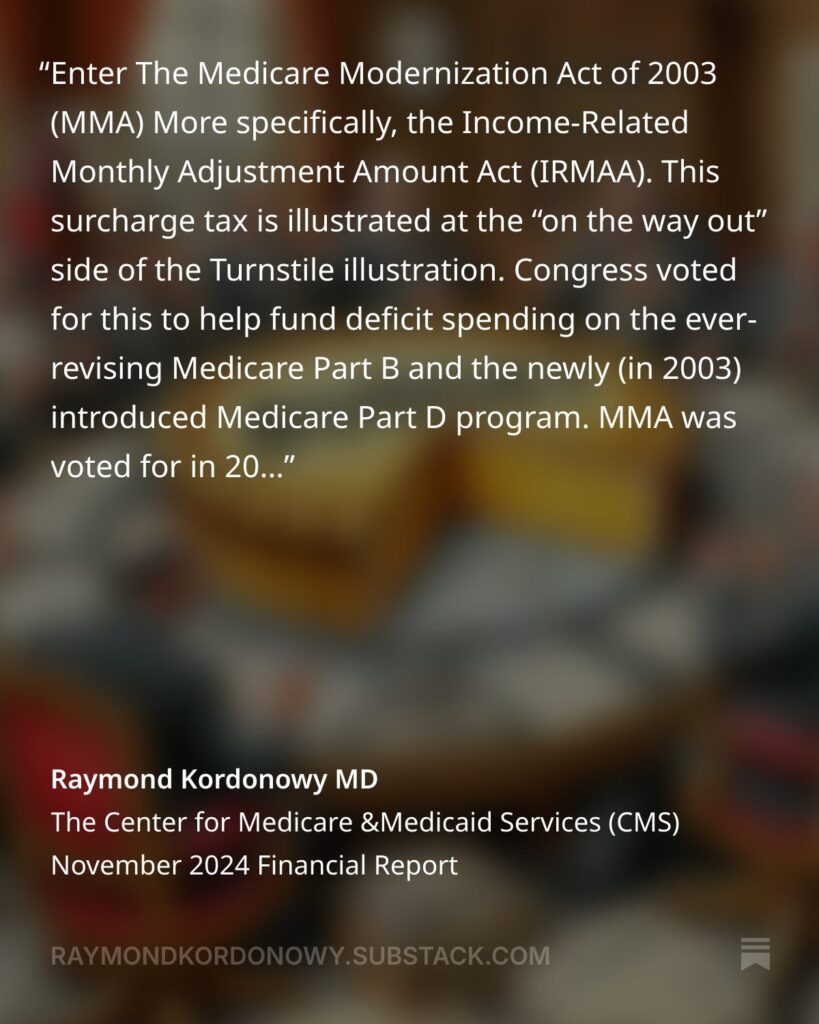
Taxation & Means-Testing: Medicare beneficiaries are facing additional taxation and means-testing pressure as recent administrations continue adding “covered services.”
Loss of Community Physicians: Local hospital systems have demoted independent community doctors from full medical staff privileges to “courtesy” or “follow-only” status, relying instead on non-physician providers for specialty care, ICU management, and surgical support. This shift is happening across the country.
Just as in the schoolyard marble example, the government cannot achieve economic efficiency without market-driven pricing mechanisms. The emerging “two-tier” system in healthcare follows the same natural incentives as that marble market: patients seeking “cat’s eye marbles” are stepping outside traditional insurance networks to secure the direct care they want.

Throughout my career, the prevailing payment model—both private insurance and Medicare—has created an artificial healthcare economy built on fee-for-service payment. In theory, fee-for-service can be an efficient way to exchange value.
What went wrong is that this model was codified, fragmented, and micro-managed. Much like the auto industry’s labor time guides, Uncle Sam created a standardized labor manual for doctors in 1992 through the RBRVS/RVU ( Resource-Based Relative Value Scale/Relative Value Unit) system. They took a static snapshot of the market and attached a rigid numerical formula to complex medical services. The passage of time makes that snapshot a shadow of present reality/value.
Under this system, payment became tied to tiny coded snippets of care, creating an accounting nightmare. Insurers and Medicare continuously contest claims, asserting that services weren’t documented properly or weren’t necessary—leading to the widespread “claim denied” frustration patients experience daily.
Furthermore, this structure requires face-to-face encounters and cannot adapt to modern technology. The RVU system turns Medicare into a proxy buyer and price-setter that no longer reflects economic reality. It is obsolete and needs to be replaced. Expanding a broken payment system to everyone is an illogical solution.
This payment structure is anchored in the past and is no longer sufficient for the modern healthcare market. Technology is blowing past the codified services payment scheme. Technology is allowing more leverage for patients to access their doctors -IF THEY AREN’T FORCED INTO A FACE TO FACE VISIT FOR CARE. Fee-for-service requires a face-to-face encounter. The RVU payment from Medicare makes Medicare the proxy buyer and price-setter and they no longer reflect economic reality. This program is obsolete and needs to be replaced. More of this for all is an absolute INSANE conclusion for any of us to desire.
It starts with – we are Board Certified Doctors. That is who is seeing and caring for you.

On January 1, 2015, I opted out of Medicare as a participating provider. Looking ahead, I dread the day I might be forced to navigate the system as a Medicare beneficiary. Access to physicians is more bottlenecked today than at any point in my lifetime, leaving many Medicare patients under the care of ARNPs and PAs rather than physicians. If you value a physician’s depth of training for evaluating your health, that choice is increasingly being eroded by traditional payment schemes.
Ten years ago, the Internal Medicine, Lipid & Wellness Practice of Fort Myers (IMLWP) was established to transition into a direct-pay/membership model independent of fee-for-service constraints. All of our office services are available for one annual fee. Membership costs are age based (historical consumption follows age ranges for medical care needs). Since then, Dr. David Marconi, MD, and Dr. Michael Barry, DO, have joined me in providing comprehensive, traditional medical care to patients who choose a direct care membership relationship for primary care.
Additionally, we offer a unique Inpatient Advocate service for our members. I designed this program to circumvent the limitations imposed by Medicare’s RVU system—specifically rules that limit payment to a single primary physician visit per 24 hours and favor hospitalist groups. By remaining independent of Medicare rules, we can directly oversee and advocate for our members during hospital stays under our Premier program.
We do not simply manage acute illnesses; we focus on comprehensive health, wellness, and long-term optimization using modern tools. We are not waiting for insurance bureaucracy to recognize the value of proactive care.
As direct primary care (DPC) pioneers, it is clear this model resonates with patients and specialists alike. More specialists are leaving insurance networks to offer direct specialty care, while telehealth and emerging technologies allow us to support patients far beyond our physical office.
Stepping outside the coded payment system allows us to deliver far greater value. Physicians stuck on the RVU treadmill rarely have time to look up and evaluate the changing landscape. By stepping off that treadmill, we can help build a system that truly serves both patients and doctors. I invite my professional peers to join us in this modern economic model.
Disclaimer: This information is for educational purposes only and is not intended to replace professional medical advice, diagnosis, or treatment. Always seek the advice of your physician or other qualified health provider with any questions you may have regarding a medical condition.

Discover direct, priority access to Dr. Kordonowy for comprehensive wellness and proactive care. Take the next step toward a higher standard of health by booking a complimentary visit or comparing our membership plans.
Southwest Florida’s premier Medical Home. Dedicated to prevention, access, and the patient relationship. Serving Fort Myers, Sanibel, Cape Coral, Bonita Springs, Naples, Punta Gorda & surrounding Southwest Florida areas.
Contact
6160 Winkler Road
Fort Myers, FL 33919
(239) 362-3005
Fax: (239) 362-3392
staff@imlwp.com