

This past March, I did a review of peptides, prompted by Secretary of Health, Robert F. Kennedy Jr’s, announcement regarding loosening restrictions on this class of molecules. The summary of a Wall Street Journal article stated “Health and Human Services (HHS) Secretary Robert F. Kennedy Jr. is poised to take action that would allow compounding pharmacies to make certain peptides that are presently restricted by the Food and Drug Administration”.
A patient case prompted me to take a bit more interest and a deeper dive into wanting to remind the public this situation is truly the wild west. I will present that case study later in this post.
I summarized a lot of information in the initial review. Since then, in our clinic, we are hearing more and more from patients reporting not only interest, but a lot of active use of various products. After more detailed queries from our doctors this week, I realize at our patient visits, we are adding more and more compounds, injections, hormone treatments and requests for hormone testing.
For me, it is astounding how many normal and healthy functioning adults are asking for “hormone panels” as if knowing your random, single moment sex hormone assays, regardless of your age, time of ovulation cycles (for females) is actionable information.
Its starting to look more like patients are driving the wagon and we board- certified, physicians are functioning not even as chauffeurs, but rather like disinterested chaperones in their health care journeys.
I thought I should get in front of this with a review and update.

It appears Secretary Kennedy is already sold on peptides. He told the reporters in the Wall Street Journal he uses them and believes he has benefitted. I followed up with an AI review and what I learned is very interesting indeed. Following the announcement, a committee was formed to review various peptides and vote on whether to recommend to the FDA approving various compounds.
Prior to the WSJ article, the FDA reportedly found:
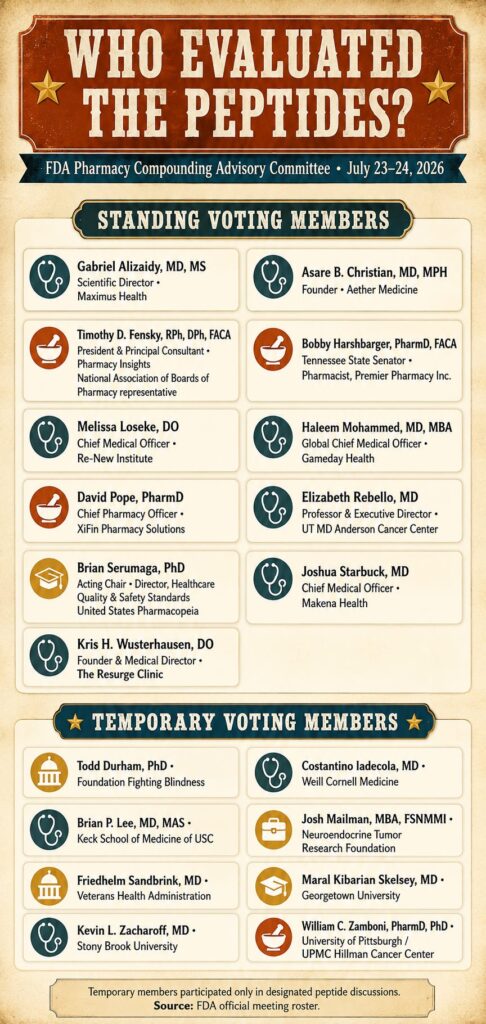
On July 23–24, the FDA’s Pharmacy Compounding Advisory Committee (PCAC) considered seven peptides for addition to the Section 503A bulk-drug-substances list.
Contrary to the recommendations of FDA scientific staff, the committee narrowly recommended six:
The advisory committee, therefore, recommended access despite the absence of the type of evidence ordinarily used to define dose, efficacy, contraindications, drug interactions, adverse-event frequency, or surveillance requirements. Health Affairs analysis
The recommendations applied to the free-base and acetate forms. The FDA’s official meeting page and briefing materials identify the substances and proposed uses. FDA PCAC meeting materials.
This was particularly striking because FDA staff had recommended against adding all seven. For example, FDA’s BPC-157 evaluation concluded that the evidence and safety concerns weighed against inclusion. FDA BPC-157 review.
I was unable to find official evidence that NIH has:
Announced a peptide-specific funding initiative arising from Secretary Kennedy’s policy;
Published a new Notice of Funding Opportunity specifically for BPC-157, KPV, TB-500, MOTS-c, Semax, Epitalon, or the other wellness-market peptides;
Awarded a new NIH grant expressly designed to establish the safety or efficacy of these six peptides following the February or July regulatory actions; or
Authorized a coordinated NIH clinical-trial program for these products.
NIH has funded peptide-related research for decades—peptide biology, endogenous signaling peptides, delivery systems, peptide therapeutics, mitochondrial peptides, and many disease-specific projects. But that broad portfolio should not be represented as NIH funding for the current compounded-peptide protocols.
It appears that an advisory committee recommended compounding access for six substances even though FDA’s scientific reviewers concluded that the human safety and effectiveness evidence was inadequate.
The FDA Pharmacy Compounding Advisory Committee (PCAC). The July peptide panel was not composed primarily of conventional peptide pharmacologists or clinical-trial scientists. A substantial portion consisted of longevity clinicians, peptide-prescribing physicians, compounding/pharmacy representatives, and business executives whose organizations could benefit from expanded peptide access.
The FDA added eight new members shortly before the July 2026 meeting. Several had readily identifiable professional or commercial connections to peptide therapy.
I will leave any further editorial review regarding conflicts of interest to real reporters. This story is looking less and less like scientific rigor and more about taking right to try out into the tumbleweeds.

What gets really scary here is the following set of bullet points.
I think it is important to recognize, presently virtually anyone asking can get these peptide injections. When I asked for a comprehensive accounting of the safety concerns surrounding today’s peptide marketplace, the resulting list contained twenty-seven separate problems. That length proves part of the point: these products have entered widespread commercial use before the scientific, regulatory, and clinical infrastructure needed to evaluate them has caught up. For readability, I have whittled that list down to the eight concerns I consider most important.
Clinical claims have outrun clinical evidence. Most promoted uses rest on cell studies, animal experiments, small or uncontrolled human studies, and testimonials—not adequately powered randomized clinical trials demonstrating meaningful benefit.
Product identity and integrity cannot be assumed. The vial may contain the wrong peptide, an inaccurate concentration, degradation products, aggregates, contaminants, endotoxin, or an undeclared active drug. A certificate of analysis supplied by the seller is not the same as independent verification.
Injectable use magnifies the risk. Injection bypasses normal gastrointestinal defenses. Meanwhile, the actual dose, bioavailability, tissue distribution, metabolism, accumulation, and elimination of many commercially promoted peptides remain poorly defined in humans.
Off-target and combination effects remain largely unstudied. Patients are frequently given peptide “stacks” together with NAD+, hormones, vitamins, and other supplements. These combinations may alter endocrine, immune, cardiovascular, neurologic, or metabolic pathways in ways that cannot be predicted from studying one ingredient at a time.
Epigenetic and long-term cancer questions remain unanswered. Peptides and coenzymes may influence growth signaling, angiogenesis, DNA repair, metabolism, and gene regulation. That does not prove they cause cancer or harmful epigenetic change, but neither have those possibilities been adequately studied or excluded—particularly with prolonged use in otherwise healthy individuals.
Consumers have few practical tools for verifying what they receive. Patients are generally unable to confirm the manufacturer of the active ingredient, distinguish a traditional compounding pharmacy from an outsourcing facility or gray-market seller, verify lot testing, or independently determine whether the vial matches its label.
Physicians are being left in an information vacuum. For many of these products, clinicians have no authoritative prescribing information, validated dose range, interaction database, monitoring protocol, contraindication list, or evidence-based discontinuation guidance. Traditional physicians are then asked to interpret symptoms and laboratory abnormalities without knowing exactly what the patient received. Yet the commercial providers of product hide under physician prescriptions!
Oversight and accountability are fragmented. Prescribing, compounding, manufacturing, advertising, shipping, and adverse-event reporting may fall under different authorities. A favorable advisory-committee vote is not FDA approval, and pharmacy compounding does not establish that a peptide is safe, effective, or clinically necessary.
The central concern is not that every peptide will ultimately prove harmful. It is that biologically active products are being marketed, combined, and injected on a scale that has outpaced the evidence needed to establish their benefits, verify their contents, anticipate their unintended effects, and guide the physicians who will inevitably be called upon when something goes wrong.

This patient has been under my care for years, so I know her usual laboratory pattern. Two findings were new: her mean corpuscular volume had risen to 101.8 fL, indicating mild macrocytosis, while her alanine aminotransferase had fallen to 5 U/L. Neither result was dramatic. Neither, standing alone, proved disease. Yet the combination caught my attention.
Macrocytosis can accompany deficiencies of vitamin B12 or folate, although it has many other possible causes. Alanine aminotransferase depends upon pyridoxal-5′-phosphate, the active form of vitamin B6, although a low ALT is neither a sensitive nor specific test for B6 deficiency. These findings therefore suggested—not proved—the possibility of disturbed B-vitamin metabolism.
The important clue came from the patient herself. She disclosed that she had been receiving an outside “longevity” protocol that included injectable NAD+ along with peptide therapies. NAD+ is not itself a peptide, but it participates in cellular energy metabolism, mitochondrial function, DNA repair, and multiple regulatory pathways. Some of its downstream metabolism passes through nicotinamide, which can be cleared by nicotinamide N-methyltransferase using S-adenosylmethionine as a methyl donor. That creates a biologically plausible question: could sustained, high-dose exposure increase metabolic demand upon methyl-donor and related vitamin pathways in a susceptible patient?
At present, that remains a clinical hypothesis—not a demonstrated adverse effect of NAD+ therapy. Human studies have not established that injectable NAD+ predictably depletes B6, B12, folate, or systemic methyl-donor stores. It certainly is scientifically plausible. Her abnormalities could still have another explanation. I have, therefore, initiated additional nutritional intervention and follow-up testing, but improvement would demonstrate reversibility and association—not, by itself, prove the proposed mechanism.
The larger lesson is what might have happened without full disclosure. Had this patient not told me about the products she was receiving elsewhere, I might have regarded these mild abnormalities as incidental. We might have repeated them at her next annual examination—or not pursued them at all. Neither of us would have had reason to ask whether an outside intervention was altering pathways that conventional medication lists and routine reference materials do not adequately address.
This is why traditional medical oversight remains necessary even when patients obtain treatment outside the traditional medical system. The earliest evidence of an unintended biological effect may not be a dramatic illness. It may be two quiet laboratory changes that become meaningful only when interpreted longitudinally, together, and in the context of a complete exposure history.
If prolonged manipulation of NAD-dependent, one-carbon, growth, or mitochondrial pathways materially alters gene regulation, DNA repair, or cellular proliferation, epigenetic and cancer-related consequences are biologically reasonable subjects for investigation. They have not been demonstrated in this patient. In theory if my clinical hypothesis is correct AND left unattended, this patient may be set up to promote malignancy.
The honest question is not whether these products have already been proved to cause such cancers. They have not. The question is whether an expanding universe of poorly documented biological exposures is introducing variables that clinicians, cancer registries, and researchers are not even measuring.
That uncertainty is precisely the problem. The products are already being injected. The advertising already promises benefit. The patients have already arrived. The scientific and clinical infrastructure needed to understand the consequences remains far behind.

The recent advisory-committee recommendations should be understood as a reason to begin serious research—not as proof that these peptides are safe, effective, or appropriate for routine use. A committee vote may open a regulatory gate, but it does not tell patients or physicians who is likely to benefit, what dose should be used, how long treatment should continue, or what harms may appear months or years later. Those questions require disciplined science.
A sensible use of NIH funding would begin with the products themselves. Before studying whether a peptide works, independent laboratories must confirm its identity, purity, concentration, stability, sterility, degradation products, endotoxin burden, and lot-to-lot consistency. Commercially distributed products should also be screened for undeclared pharmaceuticals and other contaminants. Currently these products are being sold as “for research only”. And SOME doctors are prescribing these products unabated. Clinical research performed with a carefully manufactured peptide may tell us little about products actually reaching consumers- unless the two are analytically comparable.
The next step is basic clinical pharmacology. Each peptide should be studied separately to determine how it is absorbed, distributed, metabolized, and eliminated when given by the routes consumers are actually using. Presently there is minimal human data I can reliably review on this subject. Researchers need to identify active metabolites, receptor selectivity, off-target activity, immune responses, dose-response relationships, tissue accumulation, and interactions with commonly prescribed drugs and supplements. These are foundational questions, not bureaucratic obstacles. My reviews have indicated very little data in this critical and basic start of pharmacological intervention.
Duration of use deserves to be treated as a primary scientific variable. How long must a person take the product before any measurable benefit appears? Does the benefit plateau? Does it persist after treatment stops? Does continuous exposure produce tolerance, receptor desensitization, rebound effects, hormonal disruption, immune reactions, or cumulative toxicity? Would intermittent treatment be safer than indefinite use? Most importantly, what findings should prompt a physician or patient to reduce the dose or stop treatment altogether? “Continue as long as you feel better” is not an evidence-based treatment plan. Or worse – keep going if you “feel” better.
Only after this groundwork is completed and fails to show harm, should investigators proceed to randomized, placebo-controlled trials using objective and clinically meaningful outcomes. Individual peptides should be studied before commercially popular “stacks,” so that benefits and adverse effects can be attributed to a particular intervention. Trials should include sufficient numbers of women, older adults, and people with common chronic conditions. Studies involving healthy individuals should face an especially high evidentiary standard: when the expected benefit is small or unproven, uncertainty is not neutral—the participant assumes all of the biological risk.
Short trials will not answer every important question. A national registry and biobank could follow exposed patients longitudinally while recording the exact product, manufacturer or pharmacy, lot number, dose, route, duration, indication, concurrent therapies, and adverse events. Follow-up should include endocrine, metabolic, cardiovascular, neurologic, immune, reproductive, and cancer outcomes. Carefully designed epigenetic sub-studies could examine DNA methylation, gene expression, and metabolomic changes over time. Detecting a molecular change would not itself prove injury or carcinogenesis, but failing to look guarantees that important signals will remain invisible.
Public funding has a legitimate role because industry has little incentive to finance studies that may reveal no benefit, define a narrow treatment window, or identify delayed harm. This very situation is exactly where public funding should get deployed. NIH could support independent assays, pharmacology, comparative trials, registries, biobanks, and open data infrastructure. Taxpayers should finance a trustworthy evidence commons—not subsidize unsupported marketing claims.
This is not an argument that every peptide will prove useless or dangerous. It is an argument for replacing testimonials and biochemical conjecture with measurements. Patients and physicians deserve to know what is actually in the vial, whether it produces a meaningful benefit, which patients benefit, what monitoring is necessary, how long treatment should last, what happens after it is stopped, and what risks accompany prolonged exposure. The peptide frontier may remain promising, but it should no longer remain unmapped.
Because consumers currently have few practical tools for evaluating these products, I have prepared a printable guide for identifying the prescriber, dispensing pharmacy, actual compounder, product lot, testing documentation, and regulatory status of a peptide product. Please further understand that this doesn’t guarantee you actually are receiving what is claimed to be provided.
A printable checklist for patients and clinicians evaluating pharmacies, prescribers, product labeling, and documentation.
DownloadI feel this post is equally a wake up call for my doctor colleagues as it is for patients and the public at large.
Disclaimer: This information is for educational purposes only and is not intended to replace professional medical advice, diagnosis, or treatment. Always seek the advice of your physician or other qualified health provider with any questions you may have regarding a medical condition.

Discover direct, priority access to Dr. Kordonowy for comprehensive wellness and proactive care. Take the next step toward a higher standard of health by booking a complimentary visit or comparing our membership plans.
Southwest Florida’s premier Medical Home. Dedicated to prevention, access, and the patient relationship. Serving Fort Myers, Sanibel, Cape Coral, Bonita Springs, Naples, Punta Gorda & surrounding Southwest Florida areas.
Contact
6160 Winkler Road
Fort Myers, FL 33919
(239) 362-3005
Fax: (239) 362-3392
staff@imlwp.com