
Back in February, I took a deep dive into the newly launched TrumpRx program. I was looking forward to finding some real deals for my patients. What I found at the time was underwhelming. There were relatively few drugs on the website, many of the pills being promoted at large discounts already had inexpensive generic alternatives, and several of the more interesting expensive medications simply directed patients into manufacturer programs that already existed.
I described the initial offering as “more hype than beef.”

Fair is fair. TrumpRx has changed, and my assessment needs to change with it.
The current site now displays dozens of branded “Presidential Deals,” along with hundreds of standard-priced medications, mostly generics. More importantly, the generic portion of the website is doing something that I have argued American healthcare desperately needs: it is allowing consumers to see what a prescription costs when it is purchased for cash, outside the insurance system. Maybe someone in DC read my initial blog?
That may sound like a modest accomplishment. I think it may ultimately prove to be the most important part of the entire program. It brings me back to a very simple question that most Americans have been conditioned not to ask:
Before I give the pharmacist my insurance card, what does this medicine actually cost if I simply buy it?
That question is at the heart of price discovery. For decades, our prescription insurance system has done a remarkably effective job of keeping consumers from asking it. We have effectively been brainwashed into the notion, if I don’t have health insurance, I can’t have health services. The amnesia continues.
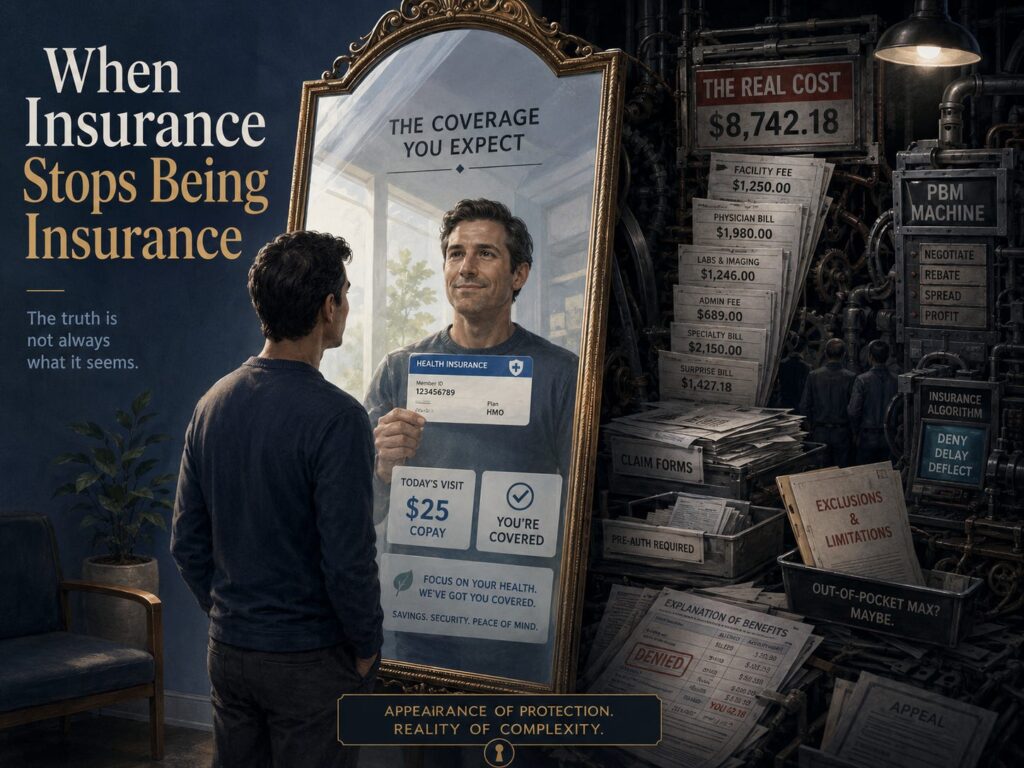
Earlier this year, I wrote When Insurance Stops Being Insurance: Medicare, UnitedHealth, and the Generic Drug Illusion. That investigation began with Medicare Advantage and eventually led me down the rabbit hole of Medicare Part D prescription pricing.
Most physicians have spent years looking at prescription costs primarily from the patient’s perspective. A patient tells their doctor a prescription costs $10 or $20, and naturally both begin thinking of that number as the “price” of the medication. When I decided to provide in-house prescription dispensing to my patient members, I knew that was a myth. That was nearly 10 years ago. Finally, Washington is being force to provide the exposure- TrumpRx is the method by which it is happening!
That copay quote is not the price at all.
When an insured patient presents a prescription card, a claim is adjudicated. The patient may contribute a $10 copay, but the insurance carrier makes an additional payment on that same prescription. In Medicare Part D, the accounting has historically been particularly visible because beneficiaries receive statements showing prescription spending and progression through the benefit. The old “doughnut hole” disappeared beginning in 2025, but the broader point remains: the patient’s copay and the total cost of the insurance transaction are not the same number.
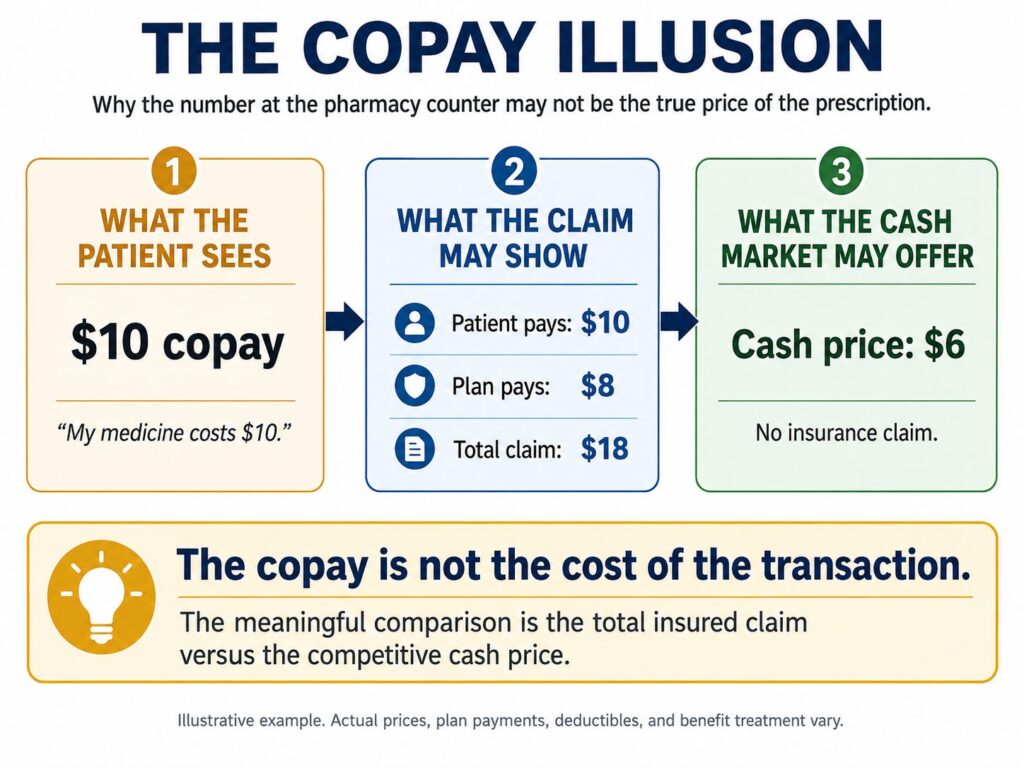
This creates what I call the copay illusion.
Suppose a generic medication can be purchased in a competitive cash market for $6. The insured patient presents a card and pays a $10 copay. They already exceeded in payment what a cash transaction can accomplish. Behind the scenes, the plan contributes another $8, producing an $18 prescription claim.
The patient walks away thinking, “My medicine cost me $10 because I have insurance.” That thought is true BUT what the individual doesn’t realize is that because of insurance they paid too much. They also paid twice- first with monthly insurance premiums reportedly to cover drug costs, with then the added copay overpayment!
In this illustrative example, the medicine could have been purchased for $6. The patient personally overpaid by $4, while the insurance pool contributed another $8 on top of that. The insurance premiums aren’t factored.
Insurance did not turn an $18 drug into a $10 drug. It turned a $6 retail purchase into an $18 insurance transaction, then hid part of the transaction from the consumer.
The particular numbers in that example are illustrative. The mechanism is not.
This distinction matters because there is no free money sitting inside an insurance company. The additional plan payment ultimately comes from premiums, government subsidies, taxes, or some combination of all three. Medicare Part D is an example where all three payments occur. Whether the money passes through the Treasury, the Centers for Medicare & Medicaid Services (CMS), a Part D sponsor, or a Pharmacy Benefit Manager (PBM), Americans are still paying the bill.
This is what I meant when I previously argued that inexpensive generic drugs generally do not belong in insurance pools
Insurance has an enormously valuable purpose. It pools financial risk. We buy homeowners insurance because our house might burn down. We buy health insurance because any of us might develop cancer, suffer a major accident, or require an expensive hospitalization.
A predictable $5 monthly prescription for lisinopril is not an insurable catastrophe. Neither is metformin, atorvastatin, or most other mature, multisource generics. These are commodities manufactured competitively and consumed predictably. What they need is not risk pooling. They need transparent pricing, efficient distribution, and a fair retail profit for the pharmacist. These medications are no more expensive than getting your cold formula off the grocery shelf!
This is why the expansion of TrumpRx into the generic marketplace deserves genuine praise. When I reviewed the program in February, inexpensive generic competition was one of the glaring omissions. Today, TrumpRx includes hundreds of generic medications and allows consumers to compare cash prices. This new, current marketplace makes it possible to search for a medication, enter a location, and look at an out-of-pocket purchasing alternative.
TrumpRx is not explicitly instructing people to abandon their prescription insurance, nor should it. BUT this public service is peeling back the onion, a truly welcome and frankly unprecedented occurrence in health care in my professional career.
There are circumstances in which an insurance copay will be lower. Some medications have zero-dollar copays. From my interviews with my patients, this is a very rare event. Subsidized patients may have very favorable coverage. Purchases made outside an insurance claim may also affect deductible or out-of-pocket accounting. That may incentivize people to go this route- a case of penny-wise and pound foolish, in my view.
The underlying message from TrumpRx is nevertheless important:
Do not assume that your insurance card gets you the best price. Compare it with cash.
That is price discovery.
For many common generic prescriptions, the cash prices I reviewed are almost embarrassingly mundane. Metformin can be found for roughly $4 to $5. Lisinopril is commonly in the $4 to $6 range. Atorvastatin can be purchased for only a few dollars. Ezetimibe is available around the $6 range, and levothyroxine is similarly inexpensive, depending on strength and quantity. These are not financial catastrophes requiring insurance. They are ordinary retail purchases.
TrumpRx is now showing that fact to the American consumer on a federal government website. I consider that very good news.
Once I start looking at cash prices, another question naturally follows. If a pharmacy can sell a prescription for $5 or $6, what did the pharmacy itself pay for the medication?
This is where I want to give considerable credit to the independent researchers at 46brooklyn Research. They have spent years digging through the drug-pricing machinery that most of us would rather not think about. One of their most useful tools is built around the National Average Drug Acquisition Cost (NADAC). This is CMS-generated survey data that estimates the invoice prices paid by retail community pharmacies for medications. 46brooklyn combines the NADAC data with other drug information and turns it into an interactive pricing resource that ordinary people can actually examine.
46brooklyn is careful about what NADAC does and does not tell us. It generally reflects pharmacy invoice prices, not necessarily the pharmacy’s ultimate net cost after every possible wholesaler rebate or retrospective adjustment. Still, it gives the public one of the best available windows into what pharmacies are approximately paying to put medicine on the shelf.
Their work repeatedly demonstrates something physicians who dispense medications directly have known for years: most traditional generic drugs are very affordable/ inexpensive.
46brooklyn shows us four separate numbers associated with the same prescription. There is the approximate pharmacy acquisition cost. There is the competitive cash price. There is the patient’s insurance copay. Finally, there is the total insurance claim, including whatever additional amount is paid through the plan.
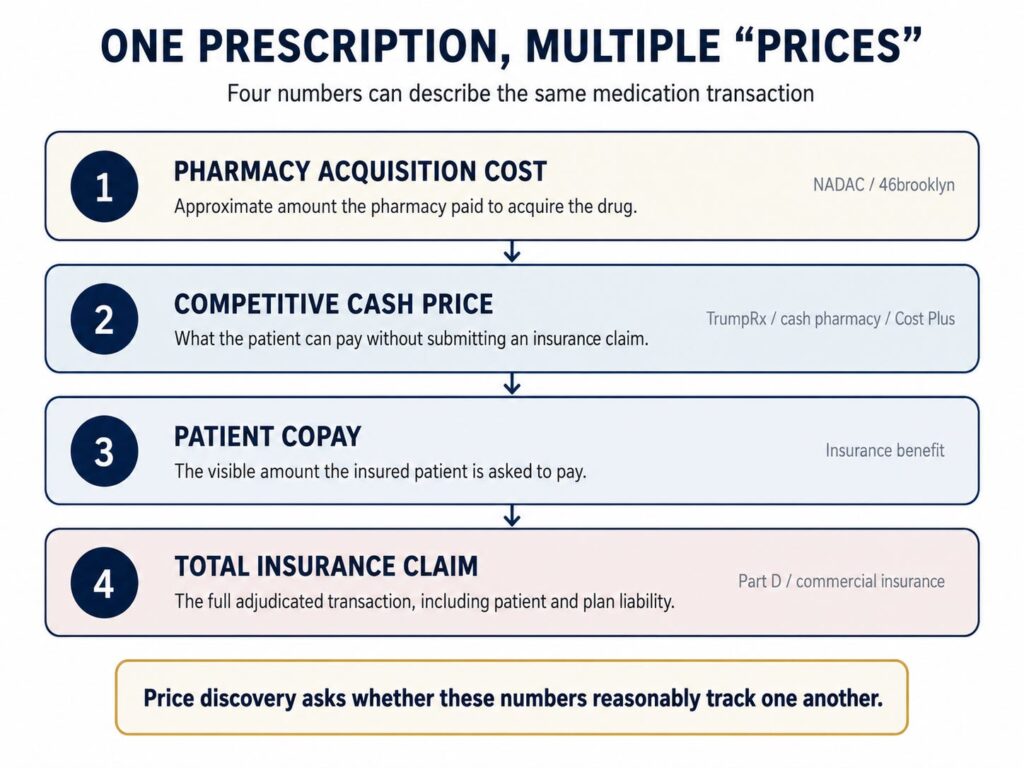
Once these four numbers become visible, the question changes. I am no longer asking merely whether the patient has prescription coverage. I am asking whether that coverage added economic value to the transaction.
This is particularly important for generics because the generic marketplace should behave like every other competitive commodity market. As more manufacturers enter, prices should fall. As acquisition costs fall, consumers should eventually benefit.
Businesses normally celebrate when their input costs decline. In healthcare, enough layers have been constructed between buyer and seller that the consumer may never know that the underlying cost fell at all.
TrumpRx’s generic marketplace begins to correct that problem.
Brand-name medications under patent protection represent an entirely different market. If one pharmaceutical manufacturer controls an important medication and the price is hundreds or thousands of dollars per month, an individual patient has essentially no negotiating leverage.
That is precisely where pooled purchasing power can have value. An insurance company, Medicare, the Department of Health and Human Services (HHS), CMS, or another very large purchaser can potentially negotiate a better price than an individual patient could ever obtain.
My position, therefore, is not that prescription insurance never makes sense. It is that our system has confused two fundamentally different economic functions.
Insurance should insure financial risk. Competitive markets should sell commodities.
For an inexpensive, multisource generic, I would encourage patients to obtain the cash price before automatically using the insurance card.
For an expensive branded drug, I would also presume nothing, but for a different reason. Compare the insurance benefit, TrumpRx, the manufacturer’s direct-pay program, and any available generic or biosimilar alternative.
The marketplace is changing quickly enough that there is no longer a universally correct card to pull out of the wallet. TrumpRx itself is helping create this new competition.
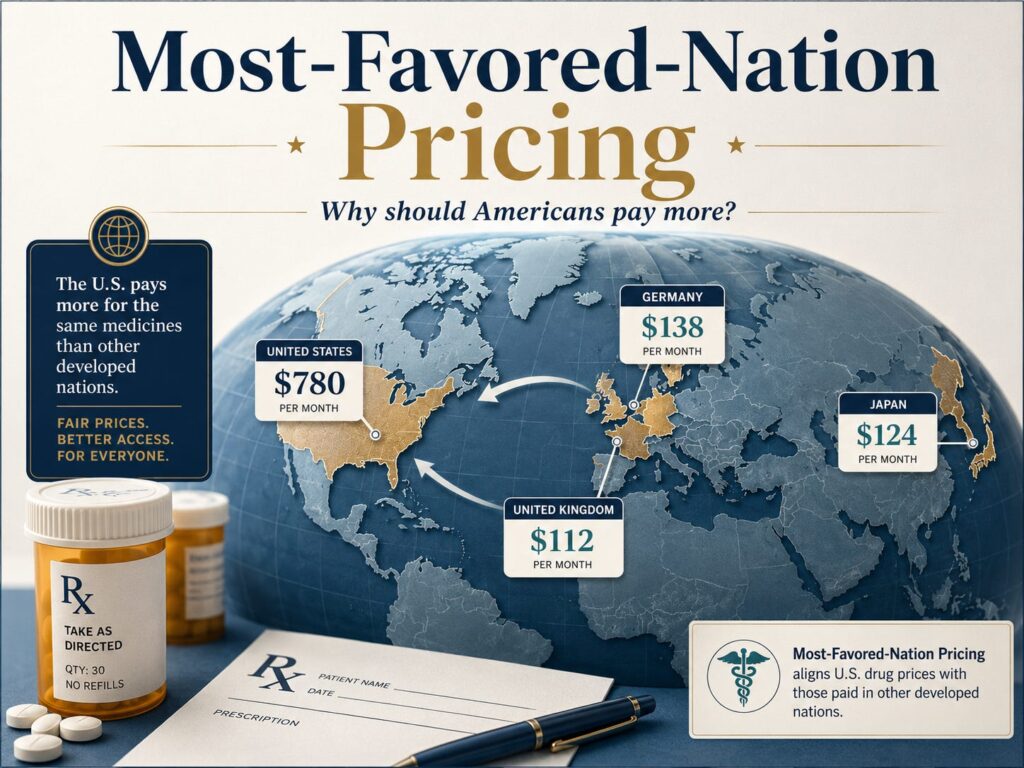
The branded portion of TrumpRx repeatedly invokes another phrase that most Americans have probably never used in a sentence: Most-Favored-Nation (MFN) pricing. The concept is relatively simple.
The Trump administration has directed HHS and CMS to benchmark certain American branded-drug prices against prices in economically comparable developed countries. The framework looks to qualifying countries within the Organization for Economic Co-operation and Development (OECD), using an economic threshold tied to U.S. gross domestic product per capita.
In plain English:
If the same patented medicine is being sold substantially cheaper in another comparably wealthy country, Americans should not automatically be financing other socialized health care nations prescription deals.
I agree with the principle.
HHS Secretary Robert F. Kennedy Jr. and CMS Administrator Dr. Mehmet Oz appear to be moving the project forward aggressively. TrumpRx is much larger and more useful today than it was when I first examined it. HHS has also clarified pathways allowing manufacturers to sell discounted medications directly for cash, including, under specified conditions, to Medicare and Medicaid beneficiaries, without billing those programs.
That change is important because it opens manufacturer-direct channels that previously presented substantial legal and eligibility complications.
Once I invoke the words MFN, however, another price-discovery question immediately appears.
How do I know which nation is actually the most favored?
There is no simple international NADAC sitting on the internet where anyone can look up the true final net price that every health system in the world pays for Wegovy, Repatha, Striverdi, or another branded medication.
Countries publish official prices and reimbursement schedules, but pharmaceutical manufacturers and national health systems frequently enter confidential rebate, volume, or risk-sharing agreements. HHS and CMS may receive information from manufacturers that ordinary citizens cannot see.
That does not mean the administration’s international benchmark is wrong. It means the public cannot yet independently reproduce it. For a program whose greatest emerging strength may be price transparency, that is an important weakness to correct.
Striverdi Respimat gives me a particularly useful example of why terminology matters.
TrumpRx currently displays Striverdi with a reference price of approximately $276 and a TrumpRx price of $35, advertising an 87 percent reduction. At first glance, a consumer could reasonably conclude that the Trump administration negotiated a $276 drug down to $35.
That is not the complete history.
Boehringer Ingelheim had already announced that its chronic obstructive pulmonary disease and asthma inhaler, Striverdi, would be available for $35 per month to eligible patients beginning in June 2024, long before TrumpRx existed.
The appropriate historical comparison, therefore, cannot simply be $276 versus $35. The $35 manufacturer price already existed prior to TrumpRx.
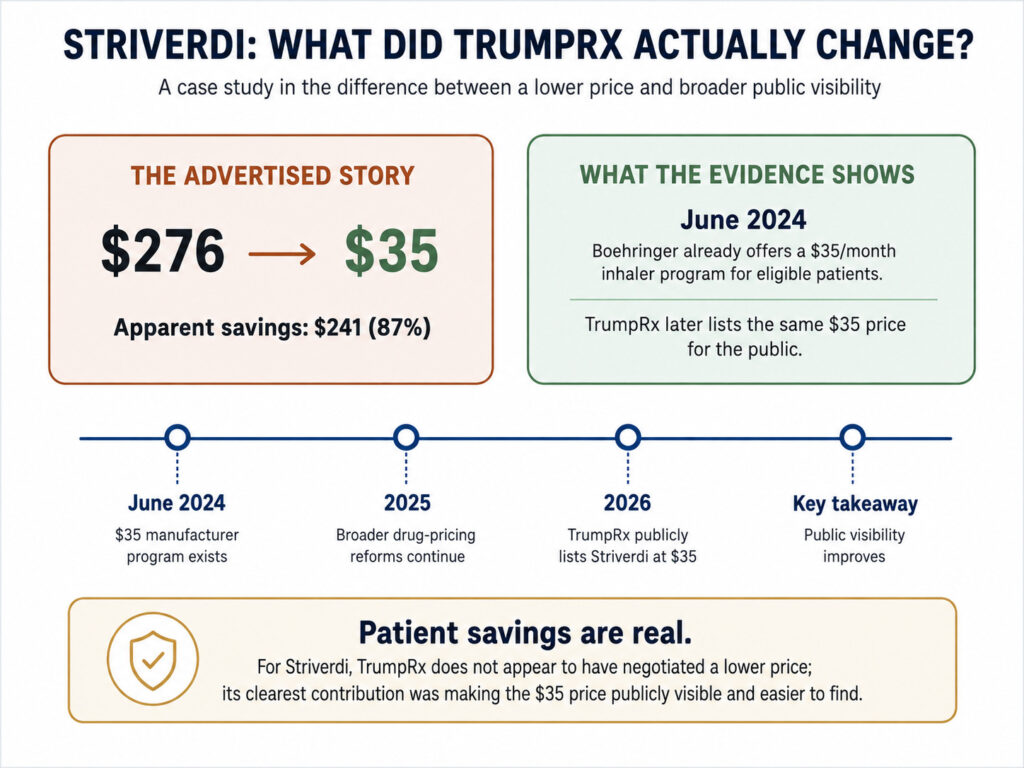
Does that mean TrumpRx accomplished nothing with Striverdi? No.
The more interesting question is whether TrumpRx and the administration’s direct-to-consumer reforms expanded access to a $35 price that manufacturers had previously made available only through more restrictive channels. The administration subsequently clarified how manufacturers can sell discounted medicines directly for cash, including, under specified circumstances, to Medicare and Medicaid beneficiaries, without submitting the transaction to the federal program.
That can be meaningful reform. It should simply be described accurately.
With Striverdi, the patient savings is real. What is much less clear is that TrumpRx created the $35 price. A more defensible claim is that the administration may have created a broader pathway to a price the manufacturer had already demonstrated it was willing to accept.
This distinction repeated itself as I reviewed other medications. Repatha’s $239 direct-pay price existed before Amgen’s formal December agreement. Xofluza’s $50 manufacturer direct-pay price similarly appeared before the later Trump agreement. Other products look different, and in several cases the lower direct cash price appears to have emerged as part of the government-manufacturer agreement itself.
I would no longer say TrumpRx is not negotiating drug prices. It appears that it is.
I would say something more precise:
The discount displayed on TrumpRx is not necessarily the discount Trump negotiated.
Sometimes the administration appears to have negotiated a genuinely new price. Sometimes it improved an existing manufacturer direct-pay price. Sometimes it appears to have broadened access to a price that already existed.
Those are three different accomplishments, and they ought to be reported separately.
This leads to what I think should be the next improvement in the program.
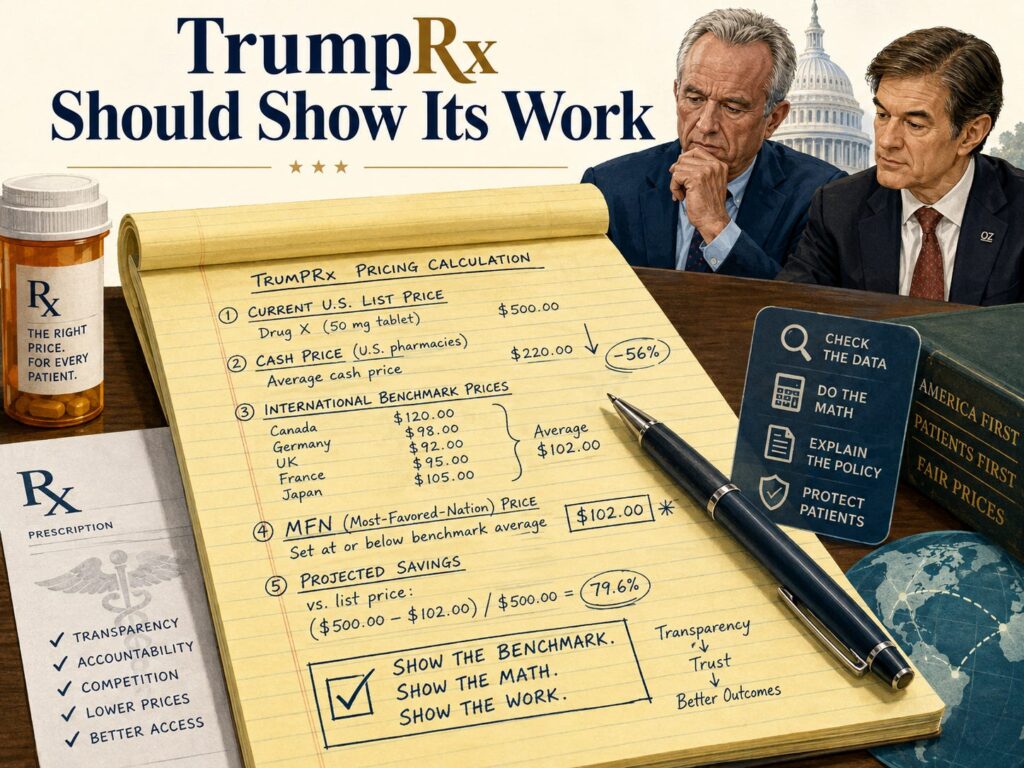
TrumpRx commonly shows the consumer a high reference or original price, followed by the new TrumpRx price and the resulting percentage savings. That is useful marketing. It is incomplete economic information.
Suppose a branded drug has a $600 list price, but its manufacturer was already selling it directly for $240. TrumpRx subsequently offers the drug at the same $240. The website can truthfully display a $360 difference from list, but TrumpRx did not necessarily negotiate a $360 price reduction. The incremental reduction from the previously available cash price was zero. The accomplishment may instead have been improved visibility or eligibility.
Now suppose another $600 drug had a pre-existing direct cash price of $500, and TrumpRx brings it to $300. In that case, the administration can appropriately claim a genuine $200 improvement beyond the prior cash market.
I would like TrumpRx to display these distinctions.
For every Presidential Deal, show the current U.S. list price, the best broadly available U.S. cash price before the agreement, the new TrumpRx price, the international MFN benchmark, and the country or countries producing that benchmark.
If the international benchmark is based on confidential manufacturer information, say so. If the price existed before TrumpRx, but access was broadened, say so. If the administration genuinely negotiated a new price, take the credit.
That would turn a politically advertised discount into something much more valuable: an auditable market price.
I also think there is an opportunity here for 46brooklyn.
They have already done the difficult intellectual work of teaching the public that list price, acquisition cost, reimbursement, and net cost are not interchangeable concepts. Their NADAC and Medicaid tools allow outsiders to examine American prescription economics with a level of transparency that often exceeds what the insurance industry itself offers.
I would encourage them to consider building an international counterpart.
The starting framework already exists. Take the OECD countries meeting the administration’s economic-comparability threshold. For each branded TrumpRx medication, assemble the official national price, the reimbursement price where publicly available, reasonable market estimates, and the TrumpRx price. Then identify which country’s publicly observable price is lowest.
Where confidential rebates prevent determination of the true net price, mark the data accordingly. Do not pretend to know something the available data cannot establish.
An international drug-pricing dashboard modeled on 46brooklyn’s existing transparency work could give patients, physicians, journalists, Congress, HHS, and CMS an independent reference point.
If Most-Favored-Nation pricing is going to become an American standard, Americans should be able to see which nation was actually most favored.
The government may possess more complete confidential data than 46brooklyn ever could. That is reasonable. An HHS Inspector General, the Government Accountability Office (GAO), or another independent auditing process could certify that the confidential benchmark is legitimate without necessarily disclosing protected contractual terms.
Government transparency and independent market analysis should complement each other.
I began this update wanting to know whether President Trump had really negotiated the discounts being advertised on TrumpRx. I have ended up more interested in something else.
The United States has constructed a prescription market in which a single medication can simultaneously possess a manufacturer’s list price, a pharmacy acquisition cost, a PBM-negotiated price, an insurer’s allowed amount, a patient’s copay, a GoodRx price, a manufacturer-direct price, a TrumpRx price, and an international government-negotiated price.
Then physicians and patients are expected to somehow know what the medicine “costs.”
The generic market demonstrates the absurdity most clearly. A competitive manufacturer may produce the drug very inexpensively. A pharmacy may acquire a month’s supply for only a few dollars. A transparent cash retailer may profitably sell it for several dollars more. Then an insurance claim is introduced, and the patient is encouraged to celebrate a $10 copay without ever seeing the rest of the transaction.
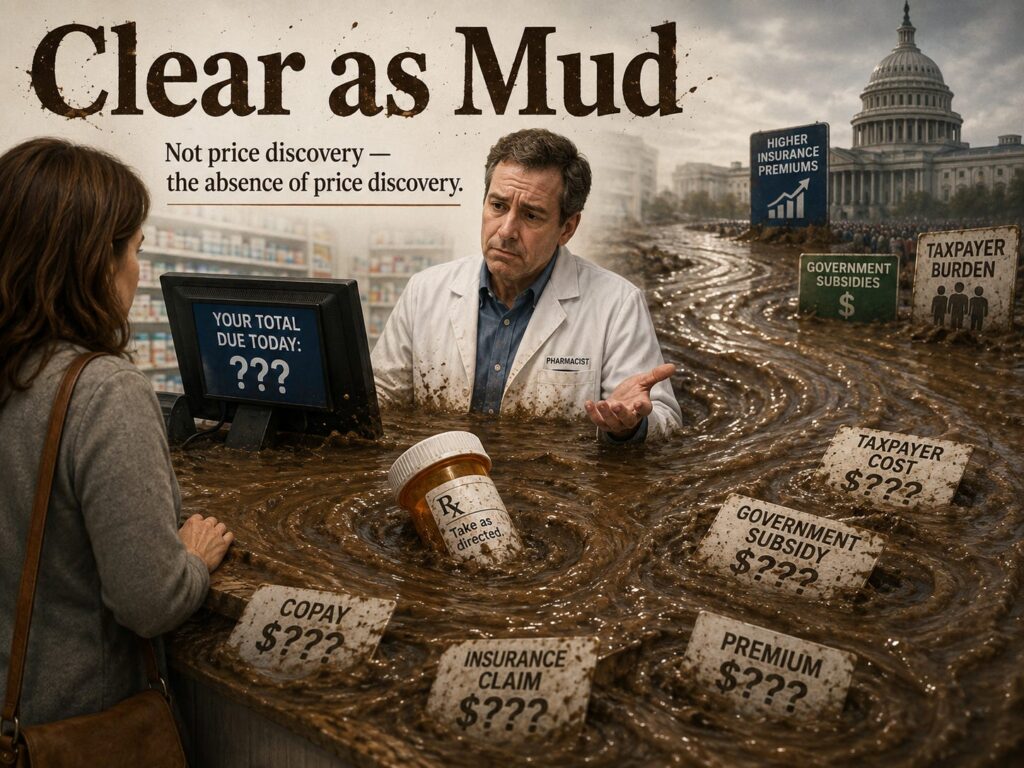
That is not price discovery. It is the absence of price discovery.
The consequences reach well beyond the pharmacy counter. Prescription spending becomes part of the cost structure of health insurance. Higher claims ultimately feed premiums, government subsidies, and taxpayer obligations.
Moving part of the bill somewhere the consumer cannot see does not make the medication cheaper.
For years, Americans have frequently paid once at the pharmacy counter and again through the insurance system that financed the remainder of the transaction. Hiding the second payment does not create savings.
This is why the generic expansion of TrumpRx interests me so much.
TrumpRx began as an initiative advertised around large negotiated discounts on expensive branded drugs. It may be evolving into something more consequential: a tool that allows Americans to see the price of medication without insurance.
That puts the consumer back into the transaction.
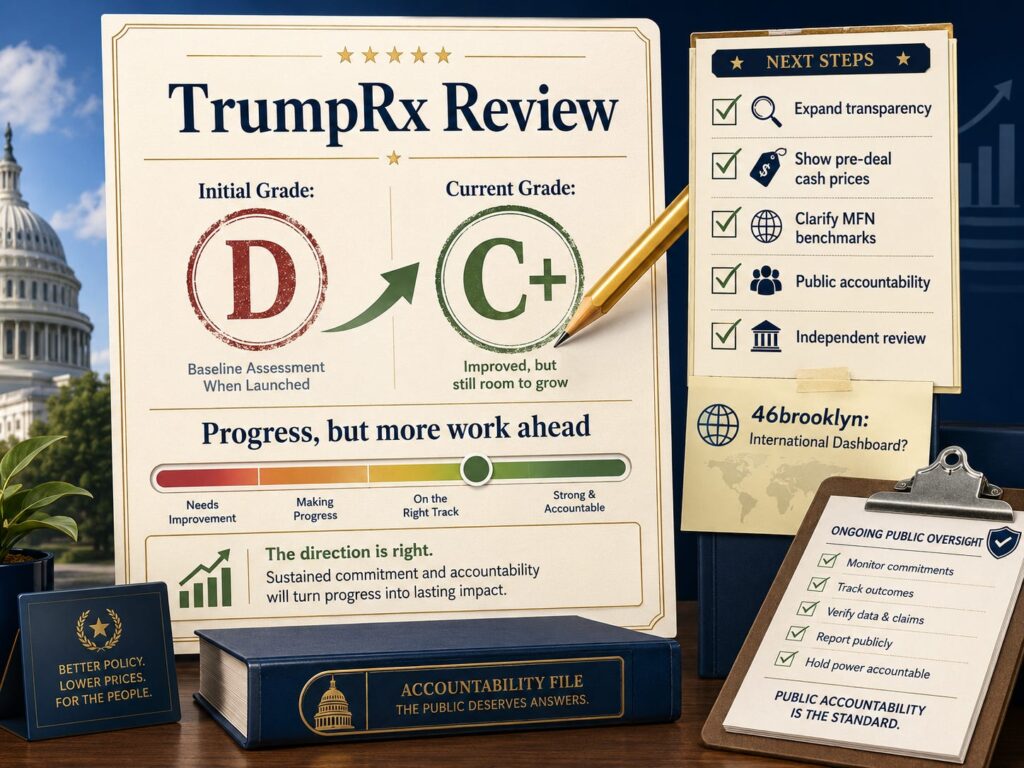
My first TrumpRx review was skeptical, and I think appropriately so, based on what the website offered at the time. The program was small, the generic market was largely ignored, and many of the purportedly dramatic discounts required considerable qualification.
That is no longer an adequate description of the project.
HHS and CMS deserve credit for expanding the platform, bringing hundreds of generic prices into view, facilitating manufacturer-direct purchasing, and beginning to give consumers a meaningful cash alternative to the traditional PBM-insurance prescription channel.
I remain skeptical of presenting the entire difference between a manufacturer’s high list price and a TrumpRx cash price as though every dollar represents a newly negotiated Trump savings. The Striverdi example demonstrates why.
I also remain unconvinced that the public has enough information to independently verify many of the international MFN benchmarks. Those are arguments for more transparency, not reasons to dismiss the initiative.
The most practical lesson for patients may be remarkably simple. Before handing the pharmacist a prescription insurance card, particularly for a generic medication, ask what the cash price is without insurance. For a branded medication, ask more questions. What does the insurance plan charge? What does TrumpRx offer? Does the manufacturer have a direct-pay program? Is there now a generic or biosimilar? Which pathway actually produces the lowest cost?
Patients need to participate in the market again. Business owners that are providing employee insurance have a fiduciary responsibility to know this information as well. Insurance companies need to reassess their insurance offerings. There is very little merit to argue businesses should be underwriting generic prescriptions, primary care or even professional office visit services in these modern times.
TrumpRx appears to be moving American prescription purchasing in that direction. That is a substantial improvement from what I reviewed in February, and I am happy to say so.
Now HHS, CMS, and the pharmaceutical manufacturers should take the next logical step: show the public how the prices were derived, show the international comparisons, and show what actually changed because of the negotiation.
Let the public see the market. Then let the market work.

Disclaimer: This information is for educational purposes only and is not intended to replace professional medical advice, diagnosis, or treatment. Always seek the advice of your physician or other qualified health provider with any questions you may have regarding a medical condition.

At IMLWP, transparent pricing and a direct relationship with your physician are part of how we practice medicine. Our concierge and Direct Primary Care model gives patients direct access to their physician, more time for thoughtful care, and clear membership pricing without billing insurance for primary care services. Take the next step toward a higher standard of health by booking a complimentary visit or comparing our membership plans.
Southwest Florida’s premier Medical Home. Dedicated to prevention, access, and the patient relationship. Serving Fort Myers, Sanibel, Cape Coral, Bonita Springs, Naples, Punta Gorda & surrounding Southwest Florida areas.
Contact
6160 Winkler Road
Fort Myers, FL 33919
(239) 362-3005
Fax: (239) 362-3392
staff@imlwp.com