

The Wall Street Journal recently reported that U.S. measles cases during the first seven months of 2026 had already surpassed the total for all of 2025. That headline accomplished what headlines are designed to do: it got my attention.
It also sent me in a direction that headlines rarely travel—back through the numbers.
How common was measles before vaccination? How often did it kill? Who is becoming infected now? Are we looking at broad population spread or intense transmission inside particular immunity gaps?
The Centers for Disease Control and Prevention’s(CDC) July 24, 2026 national surveillance update includes Florida among the jurisdictions reporting confirmed measles cases, but it does not separately identify the Collier County or Ave Maria University cluster, provide its case count, or disclose its laboratory findings.
Using AI as a tool to graph disease incidence and mortality as well as modeling out statistical support for these recent outbreak numbers, one must rationally conclude that geographic clusters with specific, mild drops in local immunity explain what is being reported.
I also inquired into how many Florida cases were laboratory-confirmed, and by what method. Was the virus cultured or sequenced? Does the evidence show vaccine failure, antigenic drift, or mostly the predictable behavior of an exceptionally contagious virus when it enters a connected susceptible group?
These are not anti-vaccine questions. They are the questions physicians should ask before turning a medical intervention into a moral loyalty test. And we can mathematically map out probabilities when we know vaccination efficacy, vaccination rates, and the natural history of measles.

I previously reviewed the controversy surrounding the universal hepatitis B vaccine dose at birth. My argument was not that hepatitis B is unimportant or that the vaccine has no value. It was that the risk to an infant born to a reliably tested hepatitis B-negative mother is not identical to the risk facing an infant whose mother is infected or whose status is unknown.
I further pointed out that in the natural history of the virus, a large proportion of children with hepatitis B resolve the infection – especially if we use contemporary management methods. The real mortality from hepatitis B occurs far downrange, affecting adults past the age of 45. We also now have highly efficacious oral antiviral therapy for that group.
In December 2025, CDC policy moved in precisely that direction. Immediate vaccination remains recommended for infants born to mothers who test positive or whose status is unknown. For infants of mothers who test negative, the CDC adopted individual-based shared decision-making between parents and clinicians.
That policy change does not prove that every criticism I made was correct. It does demonstrate that vaccine schedules are policy decisions capable of revision—not sacred texts beyond clinical examination.
Measles must receive the same independent review. Its transmission, consequences, vaccine performance and population effects differ markedly from those of hepatitis B, influenza, COVID-19, tetanus, or HPV. “Pro-vaccine” and “anti-vaccine” are political identities. Neither is an adequate method of clinical reasoning.
Before the measles vaccine became available in 1963, infection was nearly universal during childhood. Once infected, immunity was lifelong. Historic Centers for Disease Control (CDC) indicate that 3–4 million Americans were infected annually. Only about 500,000 cases were typically reported, illustrating an important denominator problem: historical surveillance counted only a fraction of true infections.
Among reported cases, CDC estimates that measles caused approximately 48,000 hospitalizations, 1,000 cases of encephalitis, and 400–500 deaths each year.
Those numbers support two conclusions at the same time.
Most infected children recovered. In a well-nourished mid-century American population, measles was generally a self-limited febrile respiratory illness with rash. Using reported cases as the denominator, annual case fatality was commonly around 0.1%—approximately one death per thousand reported cases, though it varied by year. Using the estimated 3–4 million infections as the denominator produces a substantially lower infection-fatality estimate, roughly 0.01%–0.02%. Note that prior to vaccination, nearly all cases occurred in children older than 12 months. Maternal immunity protects infants for roughtly their first year. The infection cycle followed new births.
“Most recover” is not equivalent to “harmless.” A low individual probability multiplied across several million infections produced hundreds of deaths, tens of thousands of hospitalizations, and approximately a thousand cases of encephalitis annually. Death primarily resulted from secondary bacterial infection or the encephalitis (rare). Risk was also unevenly distributed. Infants, malnourished children, pregnant patients, and people with impaired cellular immunity faced substantially greater danger.
That is the historical reality: measles was and is usually survivable, occasionally devastating, and consequential at a population scale because virtually everyone became infected – albeit at a young age, with lifelong natural immunity to follow.
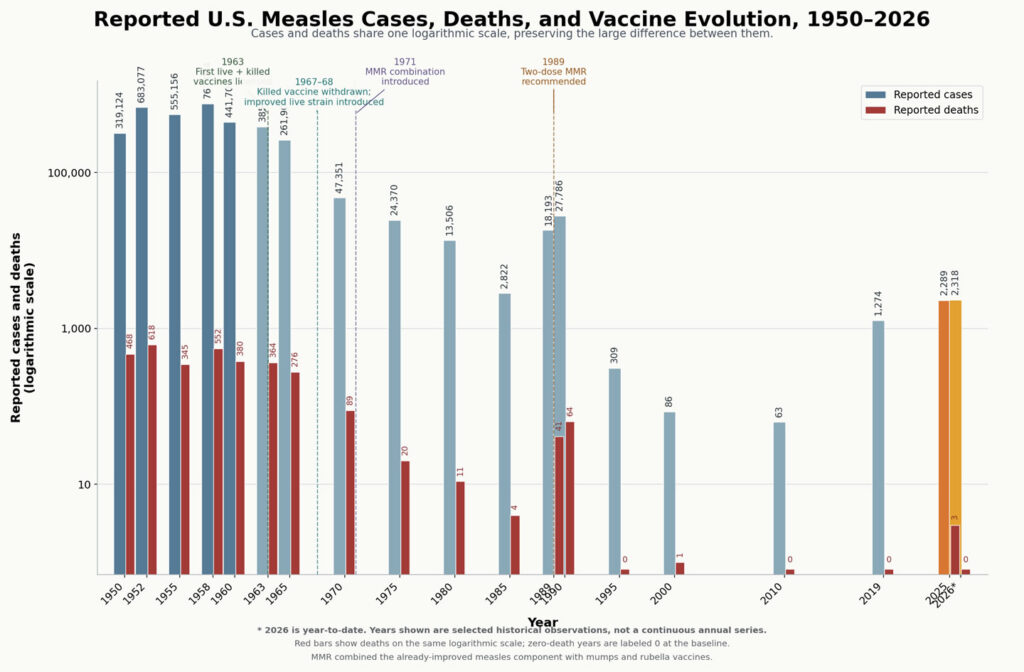
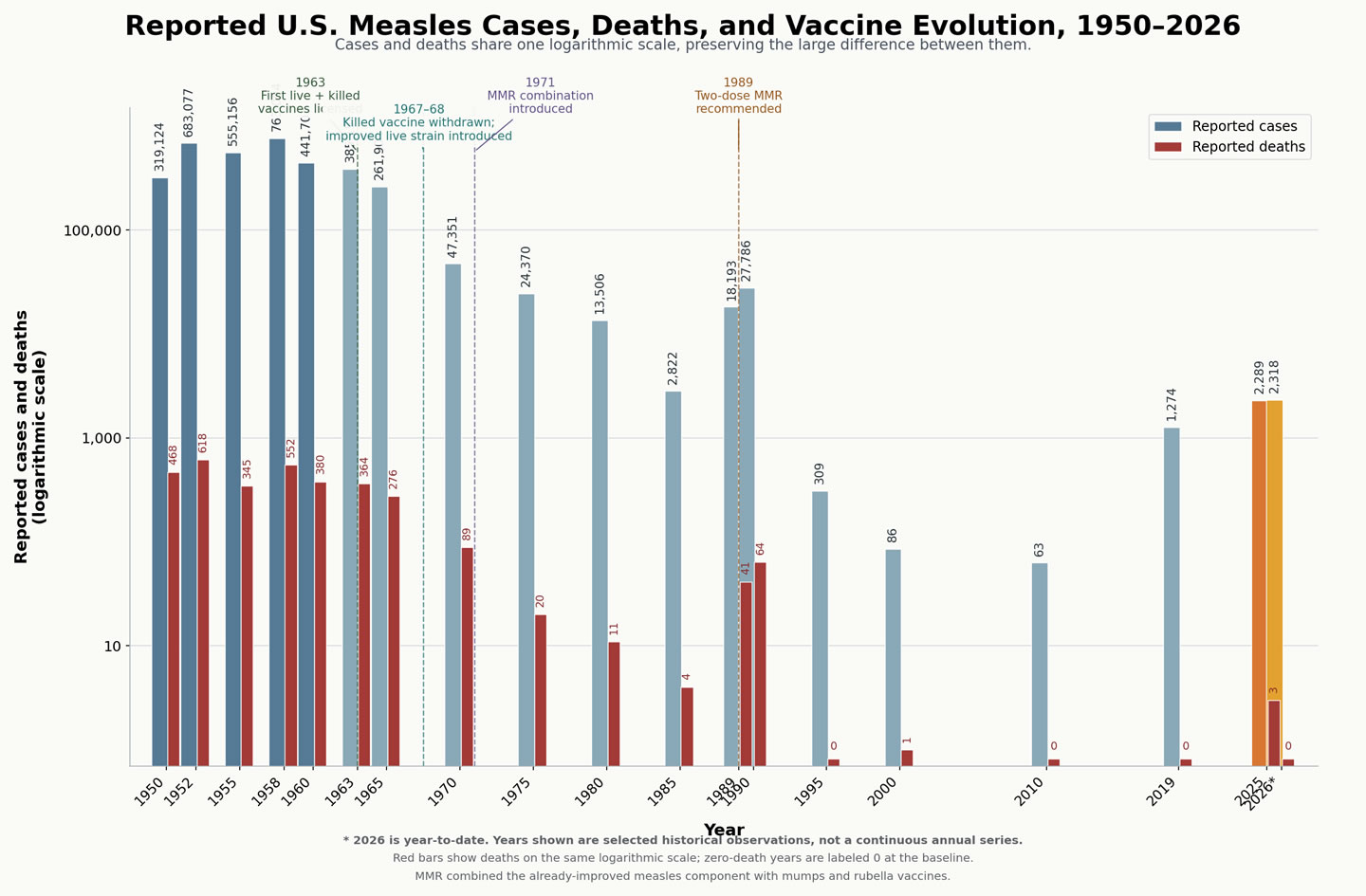
What to notice: Measles incidence fluctuated substantially before vaccination, but the sustained post-1963 decline is far larger than the earlier natural cycles. Mortality was already declining before vaccination, while vaccination sharply reduced exposure itself.
Sources: CDC surveillance and mortality records. 2026 data through July 23. Note the actual attributed death rates in red. Annual mortality dropped from 40 – 60 per pre 1990 to 0-1 cases after that. The MMR program began 1989; initial measles vaccines started 1963.
Measles mortality had already fallen dramatically before 1963 because nutrition, sanitation, antibiotics for secondary bacterial infections and supportive medical care had improved. That historical decline should be acknowledged. It tells us that a virus’s case-fatality rate is partly a property of the host and the health system, not merely the pathogen. Media articles and social media posts today often push a compliance narrative and skating past the actual mortality figures. Proper risk / benefit analysis requires providing this context to the public.
The aforementioned information does not follow that vaccination accomplished nothing. The data above indicates it has had favorable impact.
After the first measles vaccine was licensed in 1963, reported incidence collapsed. The original vaccine era itself needs clarification. Both a live attenuated Edmonston B vaccine and a killed vaccine were introduced. The killed product produced inadequate, short-lived protection and was associated with atypical measles after later exposure. It was withdrawn. An improved, further-attenuated live vaccine became the U.S. standard in 1968. MMR followed in 1971, and the routine second-dose strategy was added around 1989–1990 after outbreaks demonstrated that a single dose left a meaningful minority susceptible.
This sequence matters. The vaccine program was not born perfect. An inferior product was abandoned, the live vaccine was improved, and the schedule was revised in response to observed failure. A single dosing of the live virus conferred roughly 93% efficacy, explaining the marginal benefit early on. A second dose raised effective protection to 97%.
The principal benefit of measles vaccination was not the invention of modern supportive care. It was preventing millions of infections from occurring at all. To be optimally effective, achieving 97% antibody rate was essential to achieve the observed outcome.
The initial program primarily targeted susceptible young children:
1963: routine vaccination at 9 months
1965: shifted to 12 months
1976: shifted to 15 months
These changes reflected maternal antibody interference. Vaccinating too early produced lower seroconversion because residual maternal antibodies neutralize the vaccine virus. Children vaccinated before their first birthday were subsequently considered candidates for revaccination. CDC/ACIP measles recommendations
Mass campaigns and subsequent school-entry requirements also targeted older unvaccinated children. Adults were not initially the population focus because most adults had already experienced natural measles and were presumed immune.

Most people understand measles as fever, cough, conjunctivitis, and rash. Far fewer understand what it can do to immune memory.
Measles infects and depletes populations of memory B and T lymphocytes. After the acute illness, the immune system rebuilds, but part of the immunologic memory developed from previous infections and vaccinations can be lost. In a 2019 study using VirScan, children lost a substantial portion of their pre-existing antibody repertoire after natural measles infection; the effect was most pronounced after severe disease. Complementary work demonstrated disruption to the memory B-cell compartment.
“Immune reset” is a helpful shorthand, but it should not be interpreted as complete erasure of the immune system. The effect varies by individuals. While measles specific immunity itself becomes strong, portions of prior broader immune memory may need to be rebuilt through infection re-exposure or revaccination.
This helps explain the long-recognized surge in susceptibility to other infections following measles. It is arguably the most important measles complication that the general public—and many physicians outside infectious disease—rarely discuss.
Measles is unusual because it does not remain confined to the respiratory lining. After inhalation, the virus is captured by immune cells in the airways and uses its hemagglutinin protein to bind CD150—also called SLAMF1—a receptor highly expressed on activated and memory B and T lymphocytes as well as certain dendritic cells. Its fusion protein then permits entry into those cells. The virus travels via infected immune cells into lymph nodes and other lymphoid tissues, where it preferentially infects and depletes memory-cell populations. Attaching to a second receptor, nectin-4, the virus enters respiratory epithelial cells from the tissue side, amplifying there before shedding into the airways—explaining its remarkable contagiousness.
The key consequence is not simply temporary leukopenia. By destroying selected memory B- and T-cell clones, measles can erase part of the immune system’s accumulated record of prior infections and vaccinations. After recovery, the total lymphocyte counts may normalize, but the replacement repertoire is weighted toward newly generated cells and measles-specific immunity; some prior immune memories are permanently lost and must be rebuilt through re-exposure or revaccination. In one prospective study, children lost 11%–73% of their pre-existing antibody repertoire after natural measles. The loss is neither complete nor identical in every patient, but it can leave a child or person less protected against diseases previously encountered—or previously vaccinated against—for months to years. For me, this immune amnesia remains one of the most consequential and least appreciated risks of acquiring measles.
There is no approved measles-specific antiviral therapy that reliably aborts ordinary infection. Treatment remains supportive. Vitamin A is recommended under medical supervision in selected children with measles, particularly when deficiency or severe disease is a concern, but it is not an antiviral cure.

Historically, U.S. measles transmission increased during winter and peaked between February through May, with April often recording the highest numbers. School-term mixing, indoor contact and the inherent delay across successive transmission generations all contributed to the spring peak.
Superimposed on this annual seasonality was a multi-year cycle. Births continuously added new susceptible children. A large outbreak would depleted that pool, after which subsequent birth cohorts replenished it until another viral introduction sustained widespread transmission again. As a result, many pre-vaccine communities experienced large epidemics every two or three years.
A useful conceptual model is:
Outbreak potential = susceptible population × contact intensity × probability of viral introduction
Vaccination alters the first term. School, household, and religious-community networks alter the second. Travel and imported infected cases influence the third.
This is why seven million susceptible children spread evenly across the United States would present a vastly different risk profile than the same seven million concentrated within interconnected schools, counties, congregations and extended families. National coverage is an average; transmission occurs through networks.
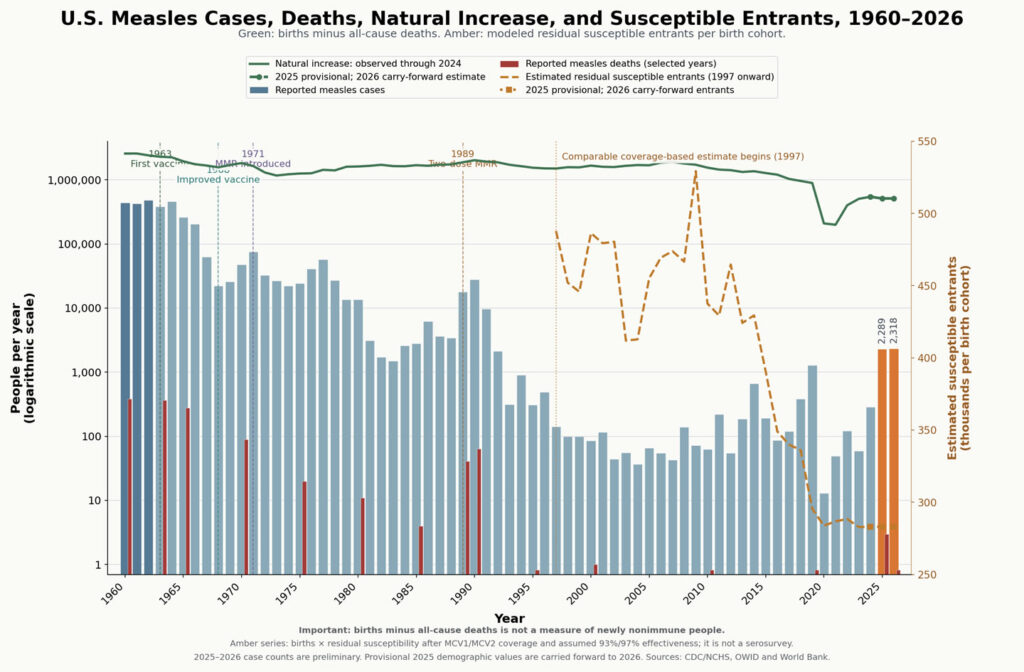
Figure 2 & 3. Epidemic Rebounds and Susceptibility Dynamics.
Notice – Measles incidence did not decline in a smooth line. Significant year-to-year fluctuations and epidemic rebounds continued after the first vaccine was introduced. Yet those temporary rebounds occurred within a much larger, sustained decline in reported disease. Meanwhile, births continued to exceed deaths by roughly one to two million people annually. This tells us that population growth alone cannot explain the disappearance—or recent return—of measles. The decisive variable is not simply how many people are added to the population, but how many remain susceptible after maternal immunity, vaccination, prior infection, and migration are considered.
Population size supplies the fuel; susceptibility determines whether it can burn; social concentration and viral introduction determine whether it ignites. Given how measles transmits and involves young susceptible hosts, it has a two-three year cycle of infectivity.
As of July 23, 2026, CDC reported 2,318 confirmed U.S. cases, compared to 2,289 during all of 2025. Ninety-three percent of the 2026 cases were outbreak-associated. That indicates active transmission, but does not mean risk is evenly distributed nationwide.
The national total combines distinct events: prolonged outbreaks in clustered under-vaccinated communities, interstate transmission, international introductions and smaller local outbreaks. The relevant public-health question is not simply, “How many cases?” It is:
Where are the cases, among whom, connected how, and confirmed by what evidence?
The vaccination pattern is informative. Major outbreaks have overwhelmingly involved people reported as unvaccinated or of unknown status. Fully vaccinated cases do occur because no vaccine is 100% effective (MMR is 97% effective for measles). Vaccine records can be incomplete, some recipients never mount adequate immunity, and intense exposure can reveal those failures. A major antigenic-escape variant would produce a conspicuous change: a growing proportion of well-documented two-dose cases across otherwise well-vaccinated populations. Publicly available national data have not demonstrated that pattern.
Sequencing from the 2025 Texas–New Mexico–Kansas outbreak also argues against a radically changed virus. All 208 genotyped specimens were D8; 94% shared an identical N-450 sequence, and the remainder differed by a single nucleotide. This is useful evidence of a dominant transmission lineage.
It is not, by itself, a complete antigenic analysis. N-450 is principally an epidemiologic fingerprint, not a functional neutralization assay of the hemagglutinin and fusion proteins. Measles nevertheless remains a single recognized serotype, and circulating genotypes have remained susceptible to vaccine-induced neutralization. At present, clustered susceptibility is a much stronger explanation than antigenic drift.
From my querying of the recent data of outbreaks for 2025/2026, it appears my home state Florida’s local outbreak isn’t clearly in the data-set.
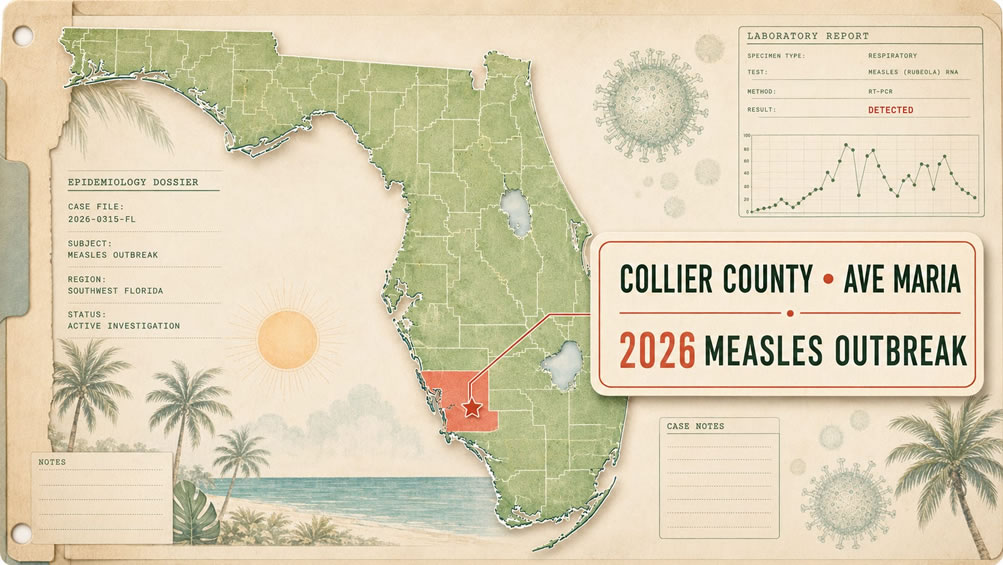
The Southwest Florida outbreak centered on Ave Maria University is unusual because it appears to have been largely a college-age outbreak, not an outbreak among infants or very young children. However, Florida’s public summaries have not provided the case-level or sufficiently granular aggregate information necessary to answer several basic questions.
Official reports have used terms such as “pediatric cases,” but that classification can encompass older adolescents and, depending on the institution or reporting convention, patients approaching college age. It should not be allowed to imply that the outbreak principally involved infants or preschool children unless the age distribution actually demonstrates that. In fact, preschool aged cases accounted for virtually none of the reported total.
Public reporting has also shifted among campus counts, Collier County totals, “confirmed and probable” cases and nurse-assessed campus cases. By February 28, Ave Maria’s public update cited 93 confirmed and probable cases across Collier County, while later stating that there were no currently nurse-assessed confirmed cases remaining on campus. These statements may all be true, but they are not interchangeable denominators.
One of the earliest publicly identified Ave Maria students said he had been vaccinated as a child and subsequently tested positive. That highlights a potential breakthrough case. While this highlights a potential breakthrough case, public evidence does not confirm whether he was the index case, that he had two documented and appropriately timed MMR doses, or that he introduced the virus to campus. Those details require state investigation data that have not been released.
Likewise, claims that more than 93% or even 98% of the campus was vaccinated cannot be interpreted without knowing:
the numerator and denominator;
whether vaccination was documented or self-reported;
whether “vaccinated” meant one dose or two;
whether the percentage applied to students, employees or the entire university community;
and how many cases occurred in each vaccination category.
An outbreak in a nominally 93%-vaccinated institution can be mathematically possible. If the susceptible 7% are socially concentrated and interact intensely, the virus does not encounter the campus average; it repeatedly encounters the susceptible subgroup. But without the actual denominators, the Florida experience cannot be used either to prove vaccine failure or to dismiss it.
Florida has reported PCR-confirmed disease, but it has not publicly released enough information to determine how many suspected cases were tested, how many were negative, how many final cases were confirmed by PCR or serology, and how many were classified by epidemiologic linkage alone. Nor have I found public Florida results for viral culture, genotyping, whole-genome sequencing or functional neutralization testing.
For that reason, I submitted a focused public-records request asking:
how many suspected cases were tested and how they were confirmed;
whether genotyping or sequencing was performed, on how many specimens, and the summary result;
whether viral culture was attempted, on how many specimens, and with what result;
and whether any neutralization or other antigenic testing was performed.
That is not an accusation. It is the minimum information needed to distinguish evidence from inference.
An important point I feel for the public to understand is that in the situation of cluster outbreaks, the math only needs a drop of 4% total vaccinated (from 97% population protected via vaccination to 93% via vaccinated/partially vaccinated or unvaccinated) to allow a cluster outbreak as happened here in Southwest Florida and apparently in the other national numbers referenced in the recent WSJ article. Many social media and mass media posts and articles are suggesting there is mass vaccine hesitancy responsible for what has been observed. That simply isn’t the case.
The United States declared measles eliminated in 2000. In epidemiologic language, elimination does not mean that no case may occur. It means continuous endemic transmission has been interrupted within a defined geography, in our case, the United States. Imported cases and limited chains can and do still occur- that is evident from the graphs I provided.
Losing elimination status would therefore be important evidence of sustained transmission, and a failure of public-health control. That is not what is happening currently. The current situation doesn’t mean that every American suddenly faces the same probability of infection. Geographic and network concentration remain essential.
This is one place where public messaging often fails. Institutions speak in population-level terms while patients hear a statement about their personal risk. A national increase from dozens to thousands of cases is epidemiologically meaningful, yet 2,318 cases among approximately 340 million people remains a very small absolute annual risk for a randomly selected American. For an unvaccinated person embedded in an active cluster, however, the risk may be extraordinarily high. Both statements can be true.
From my review and analysis we are not looking at the loss of “eradication of measles” based upon the current epidemiologic data. We have simply documented a few clusters in different geographic pockets of America. What is being observed is not the failure of a vaccination policy NOR a result of mass vaccine hesitancy for measles, contrary to what some would want the public to infer.

My review does not lead me to dismiss measles vaccination. Measles is exceptionally contagious and the vaccine highly efficacious. Natural infection usually resolves, but there is no specific curative antiviral treatment. Measles infection can result in pneumonia, encephalitis, delayed fatal neurologic disease and measurable loss of pre-existing immune memory. The modern live attenuated vaccine has decades of effectiveness data, and current outbreaks remain concentrated predominantly among susceptible people. For a child without a contraindication, particularly one entering school or living in a community with active transmission, the benefit-risk case for measles vaccination is strong.
These conclusions do not justify emotional coercion, physician shaming or imprecise reporting. It should not be used to spill over to a message that all vaccines are saving the world and those choosing not to vaccinate are anti-social. It does not transform every suspected rash into a confirmed case. It does not make one-dose, two-dose and undocumented vaccination equivalent. It does not permit “pediatric” to substitute for an age table, or national totals to substitute for cluster analysis. And it does not relieve public-health agencies of the obligation to disclose de-identified laboratory and epidemiologic evidence. Florida’s example suggests poor public health reporting and diligence. I suspect that isn’t unique to the state of Florida.
Vaccine confidence cannot be rebuilt by demanding confidence. It must be earned through product-specific evidence, honest denominators, transparent uncertainty and respect for the difference between population policy and an individual clinical decision. If vaccines are properly researched including evidence confirming no links to off target harm along with the proper risk/benefit information for informed decisions, citizens will likely make the rational and appropriate choice. The correct choice in the presence of legitimate risk, benefit and potential harm for a majority of society will likely result in acceptable infection disease prevention without any need for coercion.
Physicians should be able to say all of the following without contradiction:
Measles was historically common and usually survived.
Its U.S. fatality risk was low, but not zero.
Its population burden was substantial because millions were infected.
Immune amnesia is a real and underappreciated consequence.
Past initial vaccine had significant harm and suboptimal results
The contemporary vaccine appears safe and is nearly 100% accepted (93-97% based upon this review).
The vaccine program dramatically reduced infection, while its early formulations and schedule were imperfect and subsequently improved.
Current outbreaks are best explained by clustered susceptibility and intense contact, not demonstrated antigenic escape.
Florida has not yet released enough granular evidence to fully evaluate its unusual college-centered outbreak.
Asking for that evidence is responsible inquiry.
The antidote to vaccine tribalism is not a competing tribe. It is disciplined clinical reasoning.

Disclaimer: This information is for educational purposes only and is not intended to replace professional medical advice, diagnosis, or treatment. Always seek the advice of your physician or other qualified health provider with any questions you may have regarding a medical condition.

Have questions about measles, MMR vaccination, or your personal level of risk? Speak with Dr. Kordonowy for evidence-based guidance tailored to your health history, vaccination status, and individual circumstances. Take the next step toward a higher standard of health by booking a complimentary visit or comparing our membership plans.
Southwest Florida’s premier Medical Home. Dedicated to prevention, access, and the patient relationship. Serving Fort Myers, Sanibel, Cape Coral, Bonita Springs, Naples, Punta Gorda & surrounding Southwest Florida areas.
Contact
6160 Winkler Road
Fort Myers, FL 33919
(239) 362-3005
Fax: (239) 362-3392
staff@imlwp.com