
Last year, I argued that Americans need patient-chosen health wallets rather than a universal record controlled by the Centers for Medicare & Medicaid Services (CMS). The patient should hold the key, and the patient’s chosen primary physician should be able to reconcile the longitudinal medical record.
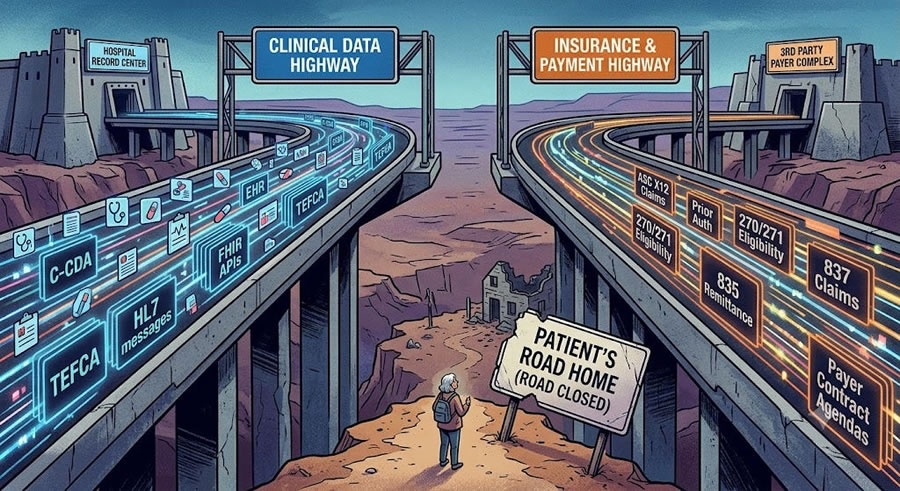
Since then, I have looked more closely at what actually happens underneath a routine medical encounter. The fragmentation is worse than a collection of incompatible portals. American healthcare operates on at least two major data highways that intersect at the patient but do not function as one patient-centered system.
This post is a bit intense, but the trends I am seeing—Artificial Intelligence (AI) vendors attempting to add value combined with an unprecedented overload of data requests inundating patients—prompted me to take a deeper dive into the health record industry. An acronym dictionary is at the end of this piece.
The two highways:
Clinical-record highway-Document illness, examination, diagnoses, medications, orders, results and treatment.
Insurance/payment highway-Determine eligibility, authorization, coverage, claims, payment, denial and remittance
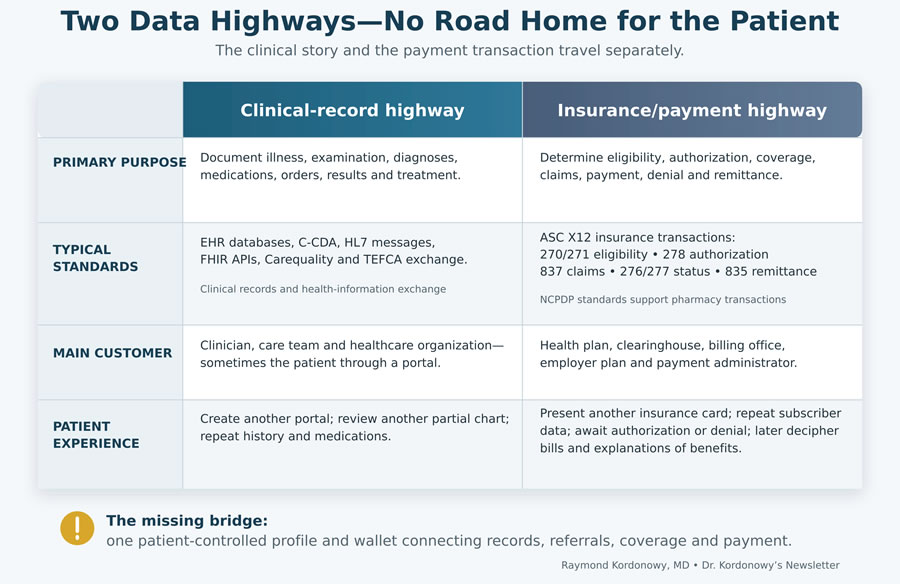
The Health Record: Electronic health record (EHR) databases, Consolidated Clinical Document Architecture (C-CDA), Health Level Seven (HL7) messages, Fast Healthcare Interoperability Resources (FHIR) APIs, Carequality and TEFCA exchange.
The Insurance/3rd Party Payer: ASC X12 insurance transactions and National Council for Prescription Drug Programs (NCPDP) pharmacy standards: 270/271, 278, 837, 276/277 and 835.
There Are Two Standard Bearers:
Clinician, care team, healthcare organization—and sometimes the patient through a portal.
Health plan, clearinghouse, billing office, employer plan and payment administrator.

Endless self-service requests from every provider: Create another portal; review another partial chart; repeat history and medications. Each time you work on the record you create an opportunity for data entry error. An error in one letter or number will result in insurance payment denial.
Intentional Chaos: Present another insurance card; repeat subscriber data; await authorization or denial; later decipher bills and EOBs (explanation of benefits).
Congress did create national standards for electronic insurance transactions under the Health Insurance Portability and Accountability Act (HIPAA) Administrative Simplification provisions. Claims use the ASC X12 837. Eligibility uses the 270/271. Prior authorization and referrals use the 278. Claim status uses the 276/277, and remittance uses the 835. Medicare participates in this administrative transaction framework along with commercial insurers.
The clinical side developed along a different path: proprietary electronic health record (EHR) databases, Health Level Seven (HL7) messages, consolidated clinical documents, Fast Healthcare Interoperability Resources (FHIR) application programming interfaces (APIs), nationwide exchange frameworks and now the Trusted Exchange Framework and Common Agreement (TEFCA)—a network of networks.
Both sides contain demographic information. Both sides have standards. That is precisely why the continuing repetition is so revealing: there is no single patient-controlled identity, demographic and coverage interface serving as the reusable source of truth across clinical intake, eligibility, referral, authorization, claim and payment.
A standard transaction is not a standard patient experience
Every medical office asks for roughly the same information: name, birth date, sex, address, telephone number, emergency contact, insurance carrier, member number, group number, subscriber relationship and responsible party. Yet patients type or write it again at the primary physician, specialist, hospital, imaging center, laboratory and surgery center.
Why? Because standardization usually begins after intake. The office collects information in its own portal or form. Staff map it into the practice-management system. That system or its clearinghouse later converts selected fields into the transaction format required by the payer. Meanwhile, the clinical EHR maintains its own patient identity and medical chart.
A FHIR Patient resource is not the same operational object as an X12 insurance subscriber. A patient’s portal identity is not necessarily the payer’s member identity. A referral order is not the same thing as a prior-authorization transaction. A clinical result is not the same thing as a paid claim. Without a universal patient identifier—and without a patient-controlled master profile—matching depends on combinations of names, birth dates, addresses, telephone numbers and plan identifiers.
We standardized many messages between institutions. We did not give the patient one reusable key, one reusable profile and one place from which to direct the transaction.
Artificial intelligence is entering the clinician’s room
The newest generation of healthcare artificial intelligence (AI) is impressive, and as a physician I welcome much of it. But follow the buyer and the workflow. Most contemporary products are being embedded inside the clinician’s EHR or the healthcare organization’s revenue machinery.
Examples:
Elation’s Clinical Insights synthesizes problem lists, medications, notes, laboratory data, vital signs and immunizations into cited chart summaries.
Epic promotes AI charting, chart navigation and population-health tools that import care gaps, risk information, claims and outside clinical data.
Athenahealth’s Chart Assistant summarizes internal and external chart information, medication changes, encounters and possible care gaps inside athenaOne.
Oracle’s Clinical AI Agent summarizes charts, drafts documentation and orders, and is extending automation into eligibility, prior authorization, coding, claims and denials.
Microsoft’s Dragon Copilot focuses on ambient documentation, information retrieval and automation within clinical workflows.
These products help the clinician digest the chart, document the visit, identify care gaps or improve revenue-cycle performance. Those are worthwhile goals. They may reduce physician burnout and make a fragmented chart more readable at the moment of care.
But making individual institutional cockpits smarter does not give the passenger a navigation system to travel between them.

The patient’s experience exists above and between all these local workflows. The patient receives one invitation for the hospital portal, another for the primary-care portal, another for the specialist, another for imaging, another for the laboratory and another for the pharmacy. Each portal only displays a fraction of the institution’s own data while remaining entirely blind to the patient’s broader journey. The inaccuracy is rampant and presently Epic’s EHR, for instance, is sending the patient self- service data review and requests for updates to try helping their large system rectify and update their record. That shouldn’t be the patient’s job.
Some emerging applications can aggregate records, and TEFCA now supports Individual Access Services (IAS), through which an individual can request access to their own electronic health information. This is real progress. Companies such as Zus can retrieve and normalize outside data for clinicians, while other consumer applications are beginning to assemble records for patients. Oracle even offers patient-facing natural-language chart review.
I therefore would not say that no one is working on patient access. The more precise—and more important—observation is that no broadly adopted product yet functions as the patient’s independent, longitudinal command center across records, demographics, referrals, scheduling, price selection, insurance, authorization, payment and return of results.
A portal lets the patient look into one institution. A wallet should let the patient direct the entire journey.
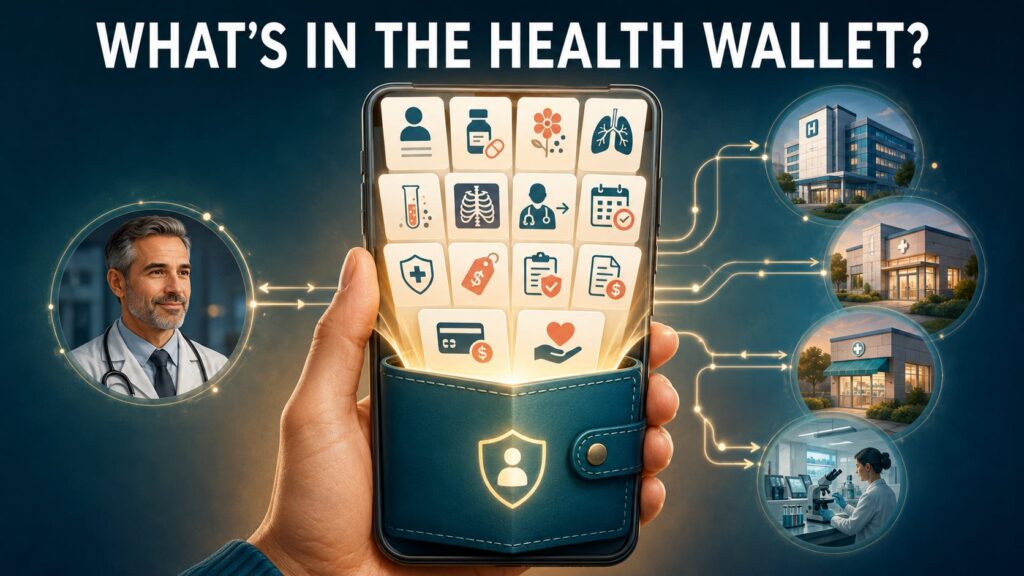
A real patient health wallet would not simply store PDF reports. It would be a patient-authorized identity, record and transaction layer.
Maintain one verified demographic and insurance profile, reusable at every authorized care destination.
Receive, upon the patient’s authorization, records from EHRs, hospitals, laboratories, imaging facilities, pharmacies and TEFCA-connected networks.
Preserve the source and date of every medication, allergy, diagnosis and result rather than silently blending conflicting lists. It would merge redundant lists that result from multiple physician and hospital record sources.
Allow the patient to designate a trusted primary physician to adjudicate clinical reconciliation. Internal reconciliation can and should still occur at the single EHR level. Each system, if authorized to communicate with the patient wallet, would then autocorrect active medication lists errors in real time.
Receive a referral and identify appropriate service locations, quality information and comprehensive prices.
Complete registration and scheduling using patient-approved information rather than another blank form.
Compare the insured pathway—including eligibility and prior authorization—with a transparent bundled cash price.
Permit the patient to choose cash, insurance-first, or cash-first with a later benefit submission.
Return the result to the wallet and chosen physician, then update the longitudinal record.
AI agents could perform much of this administrative work, but only under explicit patient directives and with appropriate physician review of clinical decisions. The technology should work for the patient—not quietly convert the patient into the product.

We are building increasingly sophisticated highways between EHRs. We already have a mature, if cumbersome, highway for eligibility, claims and payment. We are now adding AI copilots inside the vehicles used by clinicians, hospitals and insurers.
What remains missing is the patient’s on-ramp and funnel: one chosen environment that can receive information from every authorized source, carry the patient’s standing instructions, coordinate the next step and return the result to the longitudinal record.
The patient should not belong to every portal. Every authorized portal should be able to contribute to the patient’s chosen health wallet.
My earlier proposal was that the patient own the key and choose the record custodian. I would now extend it: the patient should also control the administrative identity and the instructions by which care is purchased. The chosen primary physician should restore clinical coherence. Insurers and Medicare should be payment resource options—not the organizers of the patient’s life. With this wallet concept, patients can actively CHOOSE not to indemnify themselves to pre-arranged and often exorbitant contracted payment schemes. They can ask their AI agent to actively coordinate an appointment, service, or prescription as a cash transaction and bypass the third party payment arrangement.
That is the opportunity contemporary AI has not yet fully claimed: not another institutional assistant, but a patient-directed agent capable of navigating the spaces between institutions.
AI — Artificial intelligence: Computer systems that can summarize, generate, classify or act upon information using learned models and programmed instructions.
API — Application programming interface: A defined way for one software system to request data or functions from another.
ASC X12 — Accredited Standards Committee X12: The standards organization whose electronic formats are used for many insurance transactions, including eligibility, claims, authorization and remittance.
C-CDA — Consolidated Clinical Document Architecture: A standardized clinical document used to exchange summaries such as problems, medications, allergies and results.
CMS — Centers for Medicare & Medicaid Services: The federal agency administering Medicare and working with states on Medicaid and other federal health programs.
EHR — Electronic health record: The clinician- or institution-facing system used to document and manage patient care.
FHIR — Fast Healthcare Interoperability Resources: An HL7 standard that represents healthcare information as reusable digital resources and supports modern web APIs.
HIPAA — Health Insurance Portability and Accountability Act: The 1996 federal law that includes privacy, security and administrative-simplification requirements for healthcare information and transactions.
HL7 — Health Level Seven International: The standards organization responsible for widely used healthcare data-exchange standards, including FHIR and earlier HL7 messages.
IAS — Individual Access Services: A TEFCA exchange purpose allowing an individual to request access to their own electronic health information through an authorized participant.
NCPDP — National Council for Prescription Drug Programs: The standards organization responsible for major electronic pharmacy transactions.
TEFCA — Trusted Exchange Framework and Common Agreement: The nationwide legal and technical framework connecting qualified health information networks so records can be exchanged across participating networks.
Selected sources
My original post: The Patient Health Record
CMS: HIPAA adopted transaction standards and operating rules
ASTP/ONC: TEFCA and nationwide health-information exchange
Elation Health: AI-powered Clinical Insights
Epic: AI charting and clinician workflow
athenahealth: Chart Assistant with Sage
Disclaimer: This information is for educational purposes only and is not intended to replace professional medical advice, diagnosis, or treatment. Always seek the advice of your physician or other qualified health provider with any questions you may have regarding a medical condition.

Southwest Florida’s premier Medical Home. Dedicated to prevention, access, and the patient relationship. Serving Fort Myers, Sanibel, Cape Coral, Bonita Springs, Naples, Punta Gorda & surrounding Southwest Florida areas.
Contact
6160 Winkler Road
Fort Myers, FL 33919
(239) 362-3005
Fax: (239) 362-3392
staff@imlwp.com