
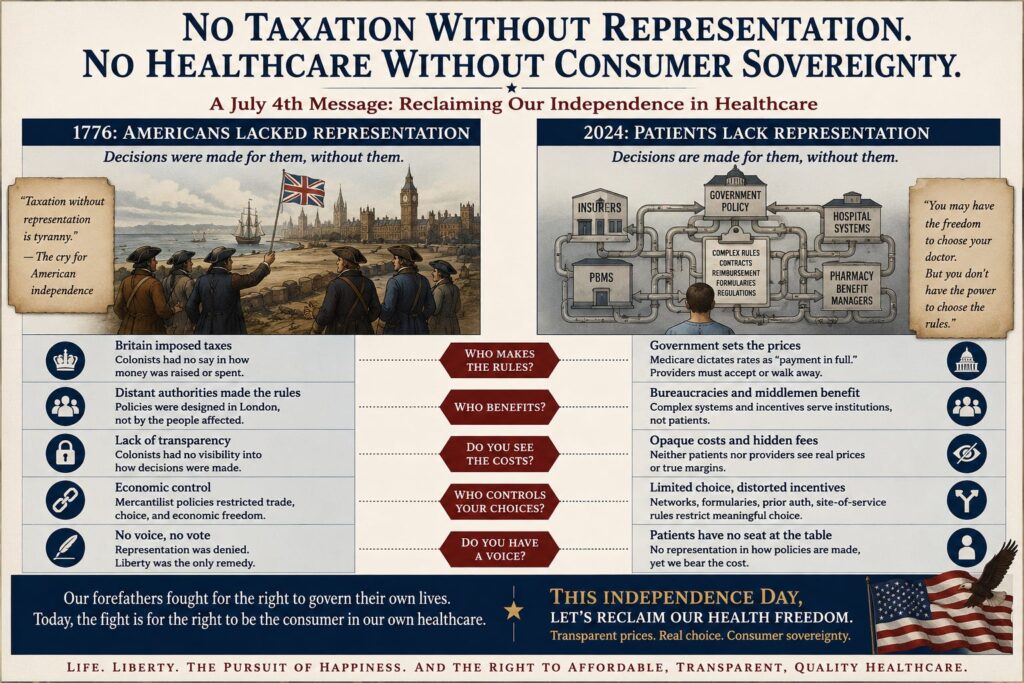
Every July 4th we celebrate the birth of a nation founded on a remarkably simple principle:
Government exists to represent the people—not to govern without their consent.
The grievance that ultimately united the colonies was not merely taxation. It was the absence of representation.
The colonists were expected to live under rules, taxes, and policies created by people thousands of miles away who neither understood nor represented their interests.
Nearly 250 years later, I wonder if we’ve accepted something surprisingly similar in healthcare.
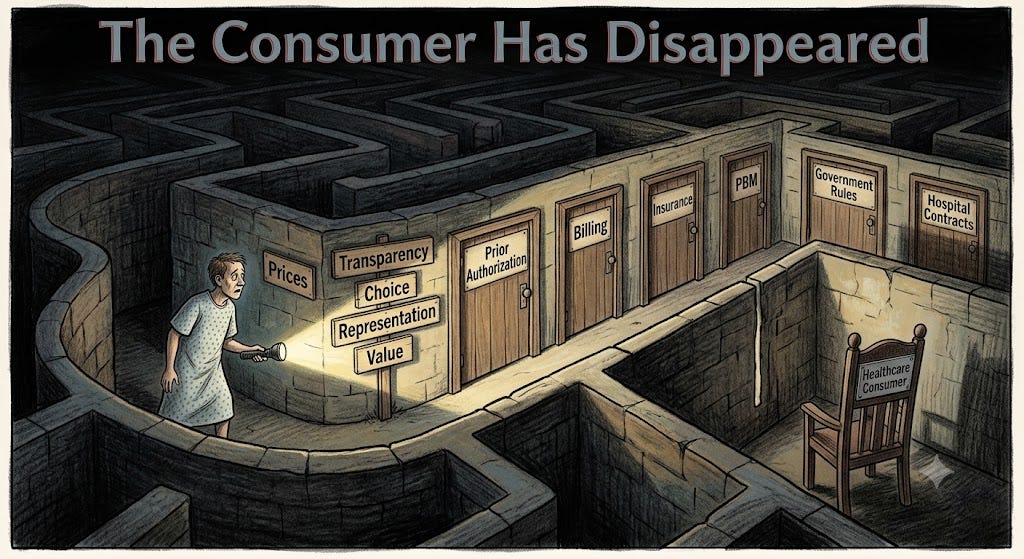
Ask yourself a simple question.
Who represents the healthcare consumer?
The patient? The person paying premiums, taxes, deductibles, copays, and ultimately bearing the consequences—has remarkably little influence over the rules that govern the system. Nearly every healthcare purchase/interaction requires third party vetting in order for the consumer event to progress.
Not most doctors- private medicine is a shadow of its historic-self presently.
Not the insurance company-they take all the money and fight constantly to hold it.
Not the employer-they just continue to go along and incorporate these costs into the business overhead.
Not the hospital-they refuse to post prices or attempt to reduce the buyer’s costs.
Not the pharmacy benefit manager- they have been given an entire shadow market to arbitrage.
Not Medicare- the program just bludgeons the market with price caps.
Not the government-regulation starts with Medicare as the monopsony buyer and crony capitalism promotes more market restriction and consumer control.
Today we are told we have “choice.” But do we really? Can we know prices before purchasing? Can we compare quality in meaningful ways? Can we negotiate? Can we influence reimbursement? Can we decide how our healthcare dollars are spent?
For most Americans, the answer is no.
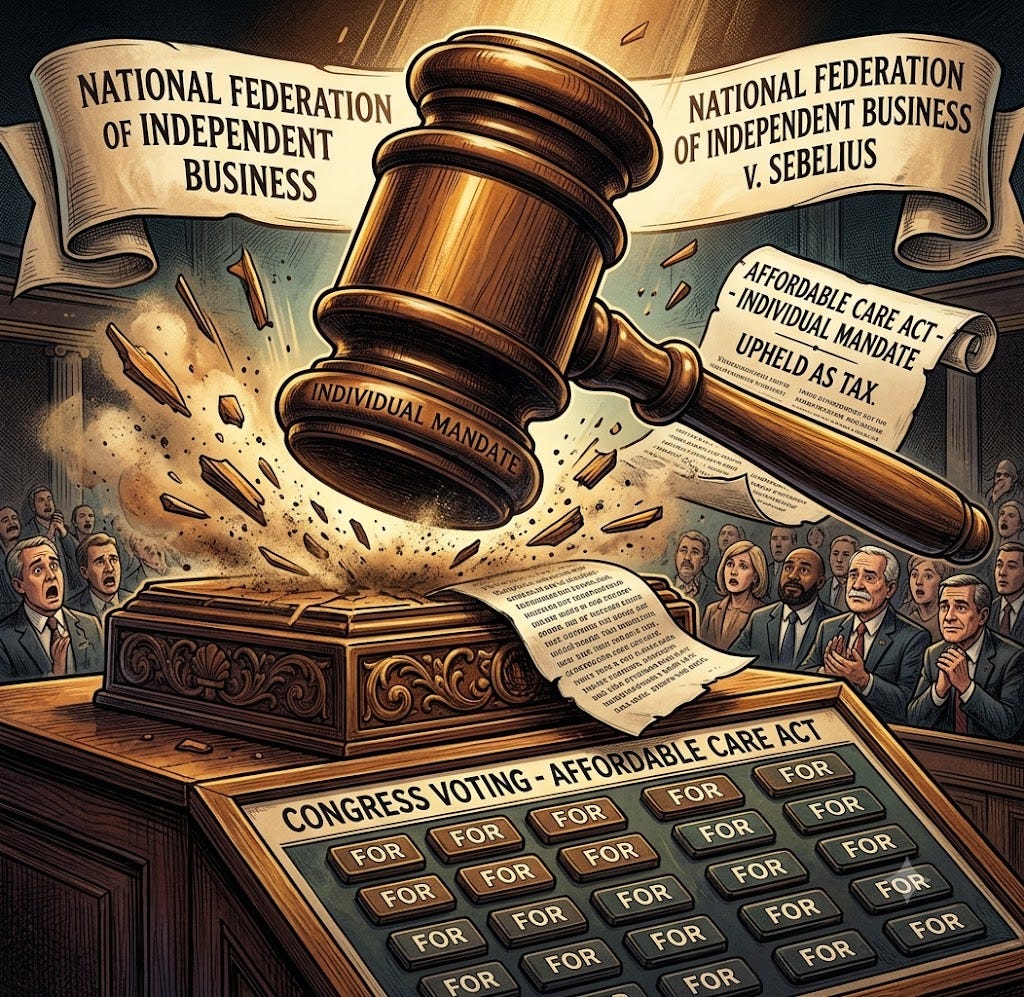
If there is one event that symbolized how far healthcare had drifted from a traditional consumer market, it was the enactment of the individual mandate under the Affordable Care Act.
For the first time in modern American history, the federal government required most citizens to purchase a private product—health insurance—or face a financial penalty. Supporters viewed the mandate as essential to creating a stable insurance market and expanding coverage. Critics viewed it as a profound shift in the relationship between the individual, government, and commerce.
That constitutional debate reached the Supreme Court in National Federation of Independent Business v. Sebelius. The Court held that Congress could not sustain the mandate under its power to regulate interstate commerce, but upheld it because the payment for noncompliance functioned as a tax. The federal penalty was later reduced to zero by the Tax Cuts and Jobs Act of 2017, although several states have retained their own mandates.
Regardless of one’s political perspective, the episode raised an enduring question that goes well beyond the Affordable Care Act:
Should government ever compel citizens to purchase a private commercial product?
For me, that question reaches beyond healthcare policy. It touches the very meaning of liberty. Independence is not simply about the freedom to choose among products offered in the marketplace. It is also about preserving the freedom to decide whether to participate in that marketplace at all. The legislation was a first time ever event forcing citizens to engage in a marketplace.
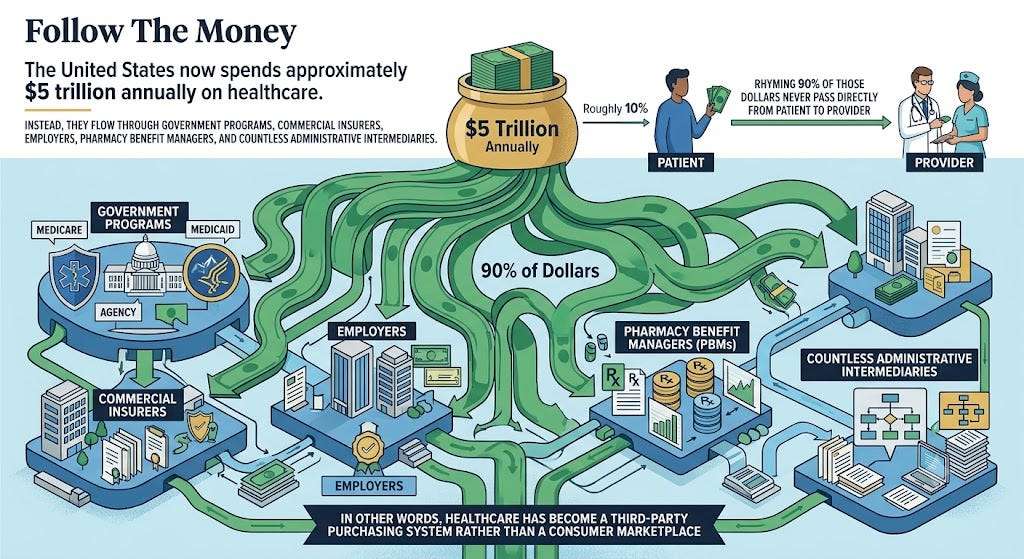
The numbers tell an extraordinary story.
The United States now spends approximately $5 trillion annually on healthcare.
Roughly 90% of those dollars never pass directly from patient to provider.
Instead, they flow through government programs, commercial insurers, employers, pharmacy benefit managers, and countless administrative intermediaries.
In other words, healthcare has become a third-party purchasing system rather than a consumer marketplace.
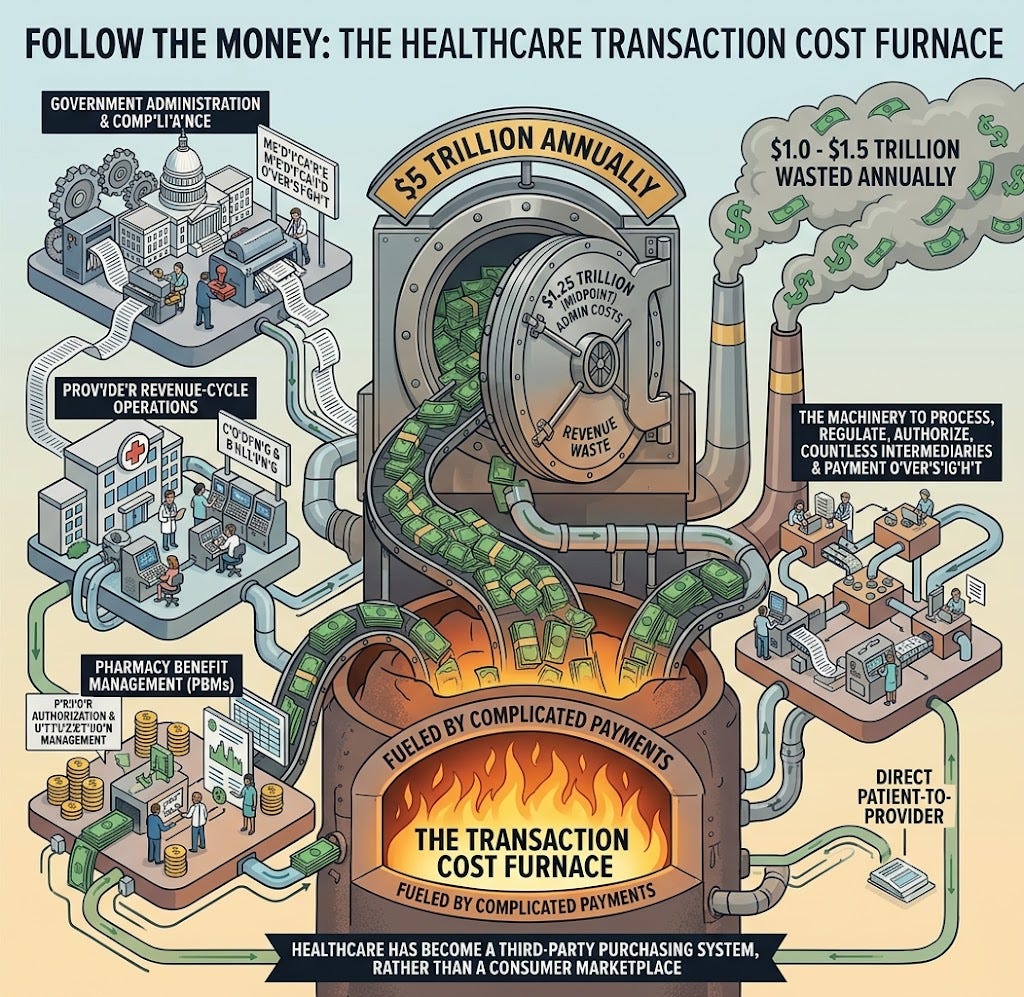
Perhaps the most astonishing figure isn’t what we spend on care.
It’s what we spend moving money around.
Using published estimates of insurer administration, provider revenue-cycle operations, utilization management, coding, billing, compliance, prior authorization, pharmacy benefit management, and other payment oversight, it is reasonable to estimate that America devotes between $1.0 and $1.5 trillion every year simply to administering and controlling healthcare payments.
A reasonable midpoint is approximately $1.25 trillion annually.
Think about that for a moment.
Nearly one out of every four dollars flowing through America’s third-party healthcare payment system is consumed not by physicians, nurses, hospitals, medications, or patients—but by the machinery required to process, regulate, authorize, document, and move the money.
The payment system has become one of the largest industries inside healthcare itself. And let’s be honest, this is just ditch digging. Banks can provide direct deposit payment for between 50 cents to a buck and a half from the seller and free to the buyer.

Now consider the opposite end of the spectrum.
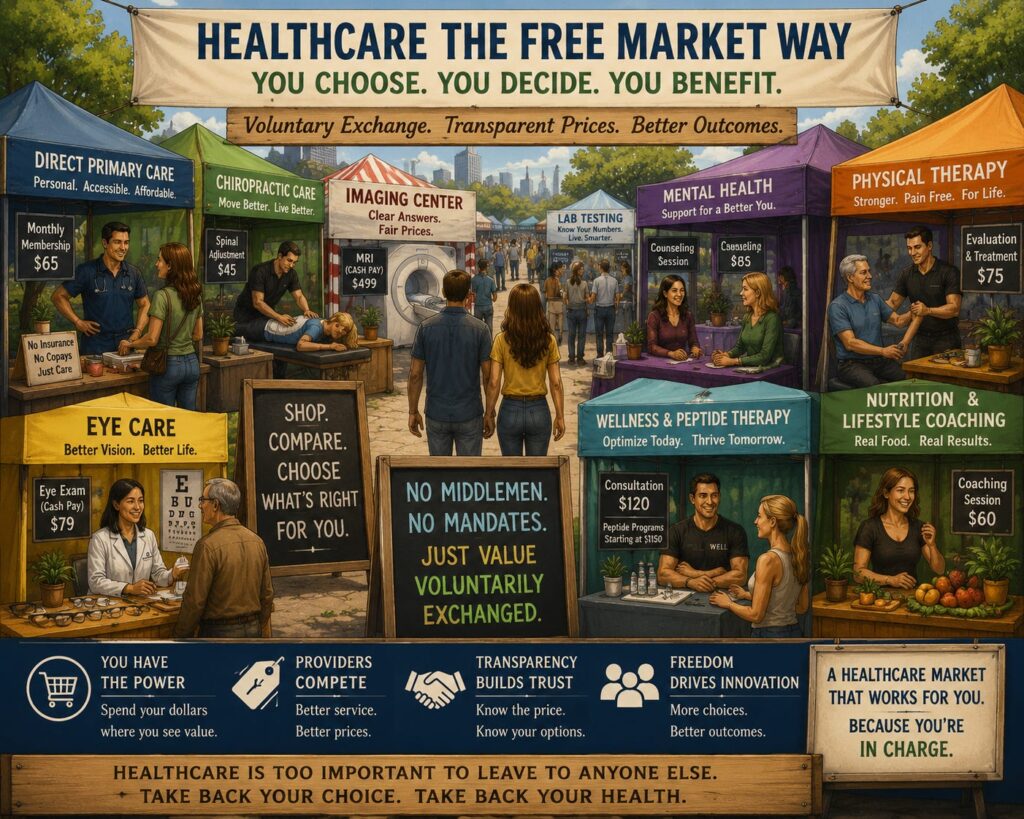
The fastest-growing areas of genuine healthcare consumerism—cash-pay imaging, direct primary care, transparent surgical bundles, wellness infusion therapy, peptide therapy, concierge medicine, and other direct-pay services—likely represent only $15 to $20 billion annually.
That is less than one-half of one percent of total U.S. healthcare spending.
Yet these sectors share something remarkable.
Patients know the price before they buy.
Providers compete for their business.
Consumers decide whether the value justifies the cost.
In short, they behave like every other functioning market in America.
Even more remarkable, we likely spend 50 to 80 times more administering third-party payment than consumers spend directly purchasing many of the most transparent, market-driven healthcare services available today. The efficiency of people accessing these services (no insurance interference) is light years faster than accessing “covered”, prepaid health care.
That ratio should stop every policymaker in his or her tracks. The honest response to these FACTs is to deregulate health care immediately.
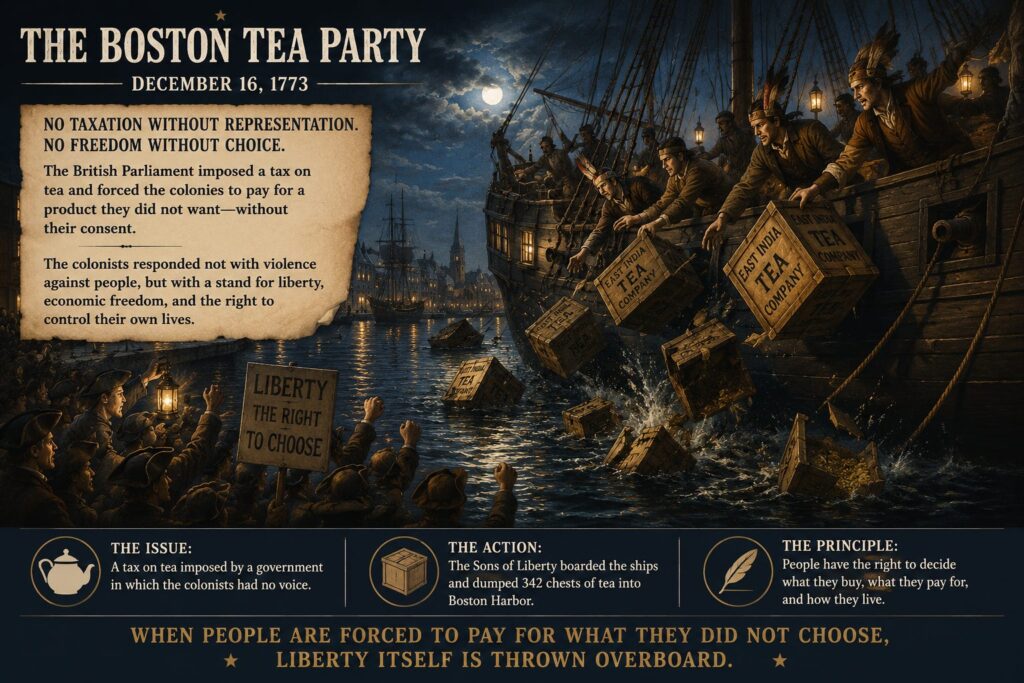
We often debate whether America should adopt more government involvement or more private involvement in healthcare.
I believe we’re asking the wrong question. The more important question is:
Where is the consumer?
Markets function because consumers exercise discipline.
They compare.
They choose.
They reward value.
They reject waste.
When consumers disappear, bureaucracy inevitably expands to replace them.
The result is exactly what we experience today: more rules, more contracts, more intermediaries, more paperwork, more prior authorization, more opaque pricing—and less accountability. And as I observe the debate on social and printed media, I continue to see the policy wonks and unbelievably my fellow physicians continue to seek more government rule making!
The American Revolution was never simply about taxes.
It was about representation.
People demanded the right to influence the systems governing their lives.
Healthcare deserves that same conversation.
Citizen buyers increasingly live under reimbursement schedules, coverage policies, formularies, utilization reviews, and contracting arrangements that they neither understand nor meaningfully influence.
Ownership of hospitals and physician practices is almost beside the point.
The real question is who controls the rules.
Who sets the prices?
Who decides what is covered?
Who determines value?
Who speaks for the citizen patient?

This Independence Day, I’m grateful America has not fully adopted the socialized healthcare systems found elsewhere in the world. Unfortunately, we are well on the way to this model, unless we claim our independence and our rights!
But I’m equally concerned that we continue moving toward a model where consumers become progressively less relevant. We must stop looking to government to maintain control over our choices in the healthcare market. We need to insist on breaking up the gross economic incompetence and present ditch-digging tasks of transaction control and price arbitrage.
Our founders believed liberty required representation. Healthcare requires something similar. Not merely private ownership. Not merely public funding. But genuine consumer sovereignty.
Because independence is ultimately about more than freedom from government.
It is about preserving the ability of ordinary citizens to shape the institutions that shape their lives.
If we lose the consumer in healthcare, we risk losing something our founders would immediately recognize:
Representation.
We hold these truths to be self-evident: that patients deserve transparent prices, meaningful choice, informed consent, and the freedom to direct their own healthcare decisions.
Disclaimer: This information is for educational purposes only and is not intended to replace professional medical advice, diagnosis, or treatment. Always seek the advice of your physician or other qualified health provider with any questions you may have regarding a medical condition.

Southwest Florida’s premier Medical Home. Dedicated to prevention, access, and the patient relationship. Serving Fort Myers, Sanibel, Cape Coral, Bonita Springs, Naples, Punta Gorda & surrounding Southwest Florida areas.
Contact
6160 Winkler Road
Fort Myers, FL 33919
(239) 362-3005
Fax: (239) 362-3392
staff@imlwp.com